
C'è una parola che a Napoli spiega tutto e non si può tradurre in nessuna lingua. Si chiama cazzimma, e prima o poi...

Free shipping in Italy
On the entire catalogue. Delivery within 3 working days, with international shipping available at checkout.

5,000+ Customers

4,6/5 su Facebook
La valutazione vera della nostra pagina, 147.000 follower. Leggi le recensioni.

Pay in 3 or more instalments
Latest posts
-
 Cazzimma: significato, origine e perché è intraducibileRead more
 -
 Chi è Minollo? Totoro parla napoletanoRead more
Non è un animale e non è napoletano di nascita. Ma come tutti quelli che passano di qui, si è fermato.
-
 Oilloc', oiccann', oillann': what they mean and how to use themRead more
Three words for «there it is» at three different distances. Neapolitan has a grammar that Italian doesn't.
-
Neapolitan t-shirts with dialect phrases: the best ones (and what they really mean)Read more
Every Neapolitan phrase is a little portable theatre: a punchline, a philosophy, sometimes an affectionate threat....
-
 McFratm, the T-shirt dedicated to Scott McTominayRead more
The new T-shirt from Napoli Tattà dedicated to Scott McTominay, Napoli's midfielder wearing the number 8 shirt
-
 "Sono napoletano, orgoglioso del mio vulcano", the new chant of Napoli's fansRead more
"Sono napoletano, orgoglioso del mio vulcano" (I'm from Naples, proud of my volcano), the new chant of Napoli's fans...
-
 Iglesia Maradoniana (The Church of Maradona)Read more
Iglesia Maradoniana (The Church of Maradona), a parody religion founded by supporters of the former Argentine...
-
 Rose Villain wears the ironic t-shirt with the word “pret” at SanremoRead more
Rose Villain had a hilarious moment at the Sanremo Festival 2025: just before stepping on stage for her evening...
-
 Tu si 'na cosa grandeRead more
"Tu si 'na cosa grande" (‘You are something great’ in Neapolitan dialect) is one of the most famous and best-known...
-
 The verb "dovere" (to have to) in NeapolitanRead more
I must, you must… it's undoubtedly one of the trickiest things to write correctly in the Neapolitan language.
Blog categories
Search in blog
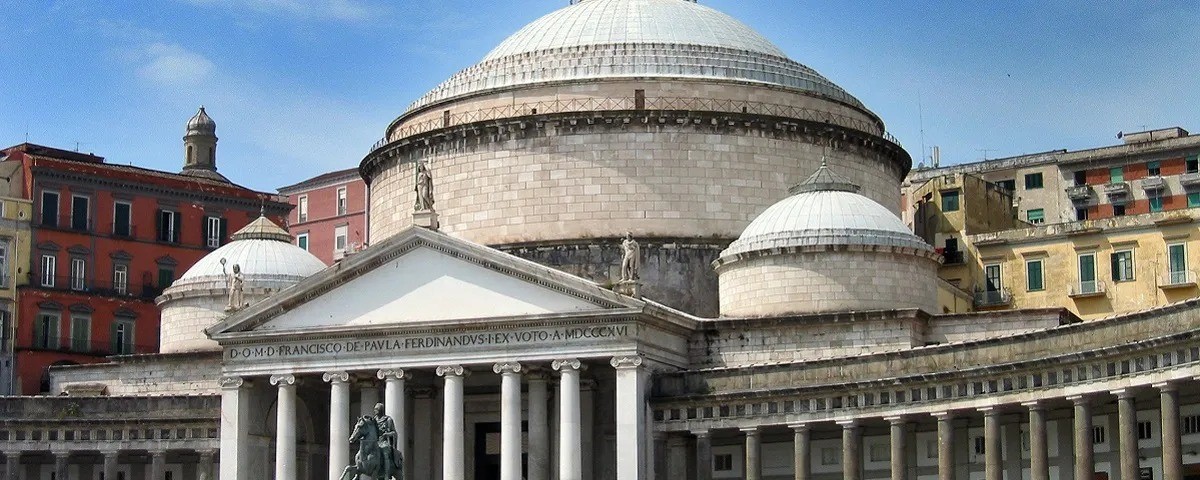
The Royal Pontifical Basilica of San Francesco di Paola
by Silvia Semonella
Over the centuries, Naples has seen the passing of countless peoples and different rulers, each of whom left their mark, both on the culture and on the city's priceless artistic heritage.
In the early years of the nineteenth century, after a long period of Bourbon rule, the city went through a period of French rule, known, in fact, as the “French decade”.
The French decade under Murat
Joachim Murat, proclaimed King of Naples, arrived in the city and set about cleaning it up; in particular, he turned his attention to the so-called “largo di palazzo” (“palace square”, which lay in front of the Palazzo Reale, the royal residence): he cleared it of the criminals who frequented it, demolished the convents and buildings that crowded it, and ordered the construction of a great square, which was to be called “Gran Foro Gioacchino” (“Joachim's Great Forum”).
He also launched a competition to decide who would be given the work: it was won by the architect Leopoldo Laperuta, who built a broad colonnade with 38 Doric columns directly opposite the Palazzo Reale. The original design called for this great structure to enclose, at its centre, a circular area dedicated to public assemblies.
The return of the Bourbons
None of this was ever completed, because in 1815 Joachim Murat was driven out of Naples and the Bourbon crown was restored: Ferdinand I of Bourbon, therefore, as a token of gratitude to San Francesco di Paola for the reconquest of the kingdom (which he believed was owed to the saint's intercession) and as compensation for the destruction of the convents, ordered the building of a church dedicated to the saint at the centre of the colonnade, expressly requesting that the dome should not rise above the height of the Palazzo Reale.
A second competition established that the works would be directed by the architect Pietro Bianchi. The project began in 1817 and was completed in 1824, giving rise to a church in a clear neoclassical style, inspired by the Pantheon in Rome. However, it was only consecrated 12 years later by Pope Gregory XVI, who granted it the privilege of being the first church in Naples with a reversed altar (that is, facing the congregation).
The structure
The façade of the church is preceded by a portico supported by six Ionic columns, on which the dedication to the saint can be read. Two side pillars support the architrave; on the left stands a statue of San Francesco di Paola, on the right one of San Ferdinando di Castiglia and, at the top, a statue representing Religion.
In the colonnade below, meanwhile, statues have been placed representing the four cardinal virtues (prudence, justice, fortitude and temperance) and the three theological virtues (faith, hope and charity).
All around the perimeter of the church, moreover, stand thirty-four eleven-metre-high columns of Mondragone marble, topped with Corinthian capitals decorated with the lily, the flower typical of the Bourbon dynasty, interspersed with eight pillars of the same height.
The central body of the church, on the other hand, is circular in shape and is paved with wonderful polychrome marble.
Inside, we also find a canvas by Luca Giordano, while, facing the entrance, stands the apse, decorated with precious stones and lapis lazuli, designed by Ferdinando Fuga and moved here from the Church of the Santi Apostoli (Holy Apostles).
How to reach Piazza del Plebiscito
The square is easily reached by Metro Line 1 (connected to Piazza Garibaldi): simply get off at the Via Toledo stop and carry on to the end of the street of the same name, past Piazza Trieste e Trento.
Posted in:
Living Naples
Related posts
-
 The Migliaccio
The Neapolitan migliaccio is a traditional cake made for the Carnival season. It's a soft, creamy cake made with...Read more
The Migliaccio
The Neapolitan migliaccio is a traditional cake made for the Carnival season. It's a soft, creamy cake made with...Read more -
 Pizza Tour: the best pizzas in Naples
In Naples, it's almost impossible to eat a pizza that isn't worth writing home about. There are hundreds and...Read more
Pizza Tour: the best pizzas in Naples
In Naples, it's almost impossible to eat a pizza that isn't worth writing home about. There are hundreds and...Read more -
 Neapolitan Day: the fountains of Naples
In Neapolitan history, fountains have played a hugely important, twofold role: first of all, they served to supply...Read more
Neapolitan Day: the fountains of Naples
In Neapolitan history, fountains have played a hugely important, twofold role: first of all, they served to supply...Read more -
 The Submerged Park of Baia
A unique and extraordinary place, closely tied to its surroundings. We find ourselves at the heart of the thermal...Read more
The Submerged Park of Baia
A unique and extraordinary place, closely tied to its surroundings. We find ourselves at the heart of the thermal...Read more -
 The National Library of Naples: the largest in Southern Italy!
It holds a collection of almost 4 million printed works, 30,000 manuscripts, a countless number of incunabula,...Read more
The National Library of Naples: the largest in Southern Italy!
It holds a collection of almost 4 million printed works, 30,000 manuscripts, a countless number of incunabula,...Read more
Leave a comment