
There's a word that explains everything in Naples, and it can't be translated into any language. It's called...

Free shipping in Italy
On the entire catalogue. Delivery within 3 working days, with international shipping available at checkout.

5,000+ Customers

4,6/5 su Facebook
La valutazione vera della nostra pagina, 147.000 follower. Leggi le recensioni.

Pay in 3 or more instalments
Latest posts
-
 Cazzimma: meaning, origin and why it's untranslatableRead more
 -
 Who is Minollo? Totoro speaks NeapolitanRead more
He's not an animal, and he wasn't born in Naples. But like everyone who passes through here, he stayed.
-
 Oilloc', oiccann', oillann': what they mean and how to use themRead more
Three words for «there it is» at three different distances. Neapolitan has a grammar that Italian doesn't.
-
Neapolitan t-shirts with dialect phrases: the best ones (and what they really mean)Read more
Every Neapolitan phrase is a little portable theatre: a punchline, a philosophy, sometimes an affectionate threat....
-
 McFratm, the T-shirt dedicated to Scott McTominayRead more
The new T-shirt from Napoli Tattà dedicated to Scott McTominay, Napoli's midfielder wearing the number 8 shirt
-
 "Sono napoletano, orgoglioso del mio vulcano", the new chant of Napoli's fansRead more
"Sono napoletano, orgoglioso del mio vulcano" (I'm from Naples, proud of my volcano), the new chant of Napoli's fans...
-
 Iglesia Maradoniana (The Church of Maradona)Read more
Iglesia Maradoniana (The Church of Maradona), a parody religion founded by supporters of the former Argentine...
-
 Rose Villain wears the ironic t-shirt with the word “pret” at SanremoRead more
Rose Villain had a hilarious moment at the Sanremo Festival 2025: just before stepping on stage for her evening...
-
 Tu si 'na cosa grandeRead more
"Tu si 'na cosa grande" (‘You are something great’ in Neapolitan dialect) is one of the most famous and best-known...
-
 The verb "dovere" (to have to) in NeapolitanRead more
I must, you must… it's undoubtedly one of the trickiest things to write correctly in the Neapolitan language.
Blog categories
Search in blog
Mamma d' 'o Carmene
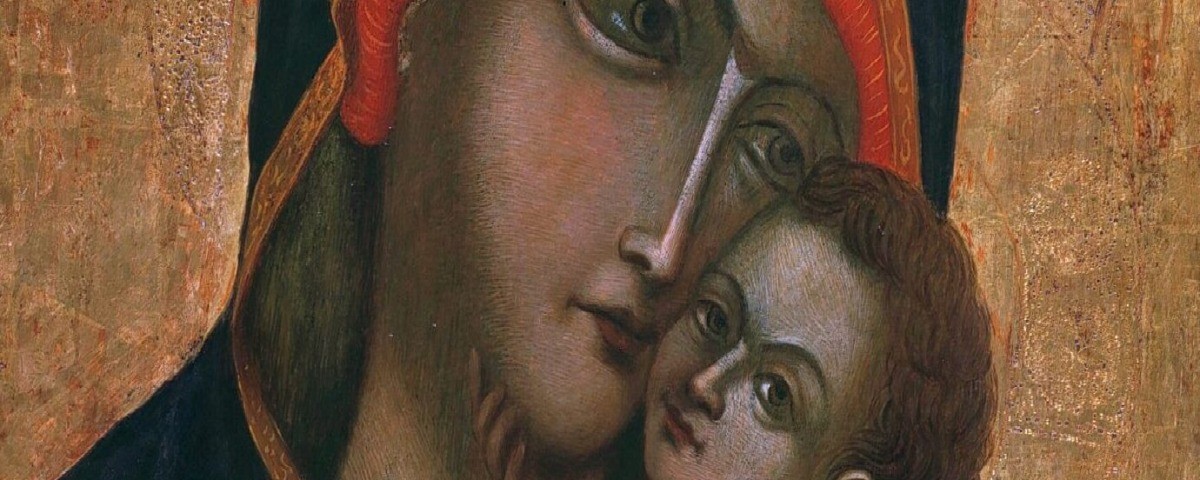
Who hasn't exclaimed it at least once in their life? Well yes, behind this popular expression lies an icon: the strong bond with the religious image of the Madonna del Carmelo (Our Lady of Mount Carmel), also known as the "Madonna Bruna" ('Brown Madonna') for her dark skin, reminiscent of the Byzantine icon. But why is this Virgin so beloved by the Neapolitan people? What wonders do they reveal to us? To find out, we need to take a leap into the past. The cult of the Madonna del Carmine, or Our Lady of Mount Carmel, is much older than one might think. In fact, it is mentioned in the Old Testament, in the First Book of Kings, which tells of the building of a church on Mount Carmel in Israel, following a series of events. Legend has it that some monks, fleeing the terrible persecutions by the Saracens in Palestine, arrived in Naples bringing with them the sacred image of the Madonna, originally venerated on Mount Carmel in Israel. Once in the city, they placed the sacred icon inside a grotto near the seafront, which had previously been dedicated to the cult of San Nicola (Saint Nicholas). The temple dedicated to the Madonna del Carmine was built between 1283 and 1300, but later renovations in the 17th and 18th centuries erased its ancient medieval appearance. The Madonna del Carmine was the object of great veneration by the Neapolitan people from the earliest times, and her strategic proximity to Piazza Mercato, the city's commercial heart, encouraged devotion among the humblest folk and the spread of her cult. In some documents from 1457, when the cult reached its peak, it was stated that the Neapolitans were deeply bound to the Madonna del Carmine, to whom they addressed their prayers and thanks.
Her feast day is set for 16 July, according to the Christian calendar, marked by a series of events that involve the ancient heart of Naples. The origin of this festival most likely dates back to 1500, when the icon of the Madonna Bruna was carried in procession to Rome, followed by miracles along the pilgrimage route. Accounts from the time speak of the famous "Incendio del Campanile" ('Burning of the Bell Tower'), also called the "castello" ('castle'), perhaps to commemorate the siege of the Bell Tower, used as a military fortress, which was lit up with spectacular fireworks. The celebrations, which reached their peak in 1700 on the two-hundredth anniversary of the Madonna Bruna's pilgrimage to Rome, became even more spectacular with the addition of illuminations, local firework displays and orchestral music. Naples, under the rule of Carlo III di Borbone (Charles III of Bourbon), experienced a cultural and traditional renaissance, thanks also to the generous contribution of royals and nobles who, through significant donations, ensured the continuation of the Festa del Carmine (Feast of the Carmine).
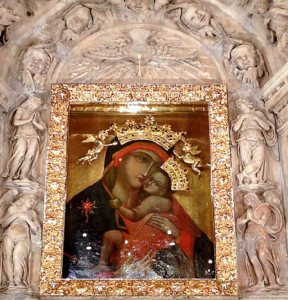
The icon of the Madonna Bruna, familiar to everyone, is probably the work of a master of the 13th-century Tuscan school, rather than, as was once believed, an artist of Eastern origin. The painting depicts the Virgin with the Child within a rectangular format, one metre high and 80 cm wide. Created using the tempera technique, it portrays the Madonna and the infant Jesus in an attitude of tender intimacy between mother and son, in a natural and knowing bond. For this reason it is called "l'immagine della tenerezza" ('the image of tenderness'), as it evokes a powerful emotional impact, born of prayer and contemplation, which inspires love and veneration for the Mother of God and of mankind. The Madonna's dark face evokes salvation, inspires protection and stirs feelings of piety and mercy in Christians. Within the painting one can note numerous symbols that explain its messages: the gold of the background and the halo, which indicate the holiness of Mother and Son, as well as their association with the Sun, symbol of divine light; the blue colour of the mantle is linked to motherhood and symbolises water, a synonym for fertility. The red colour celebrates the triumph of the love uniting mother and newborn, just as the flesh-coloured tunic, representing the incarnation of Jesus, reminds us that he is the Lamb of God. The star with a trailing point on the Madonna's mantle symbolises her perpetual virginity, before, during and after childbirth. The gaze of both figures is turned towards the viewer, expressing Jesus's redemptive mission and Mary's part in it. The whole scene is a succession of sweetness and infinite tenderness, in which the Virgin shows her right hand in answer to our plea: "Mostraci Gesù, frutto benedetto..." ('Show us Jesus, blessed fruit...'), and points us the way: "Ecco il cammino, la verità e la vita" ('Here is the way, the truth and the life').
The Legend of the Miraculous Crucifix. For the faithful of the Madonna del Carmine, this «miracle» testifies to the authenticity of the love and protection that the Virgin Mary has bestowed on the Neapolitan people for many centuries. The legend of the miraculous Crucifix is set in the 15th century, when the Angevins and the Aragonese were fighting over the kingdom of Naples and control of the city. King René of Anjou, then regent, in order to protect his territories against Alfonso of Aragon, who had entered the city, had his artillery positioned on the Campanile del Carmine (the highest point in the city), which had been turned into a military fortress, its walls having been built in 1170. The guns were aimed at the enemy encampment at Borgo Loreto. Legend and history tell that on 17 October 1439 the infante Pietro (brother of King Alfonso) lit the fuse of a great bombard called the «Messinese», that is, a huge cannonball (still preserved intact in the crypt of the Chiesa del Carmine), which smashed through the church walls, crossing the apse until it struck the Crucifix. Everyone assumed the Crucifix had been completely or partially destroyed, only to witness an extraordinary event: the wooden Christ, to avoid the blow, bowed his head onto his right shoulder, suffering no damage at all. A true miracle, still visible today. The following day, the infante Pietro of Aragon, not satisfied, wanted to fire the Messinese again, but a shot fired from the bell tower (divine punishment?) by the bombard known as the "Pazza" ('the Mad One') took off the infante Pietro's head, and after a series of struggles, King Alfonso brought the fierce battle to an end. On 2 June, King Alfonso of Aragon entered Naples in triumph and wished to go to the Carmine to venerate the miraculous Crucifix, thereby making amends for his younger brother's thankless act, and had an important tabernacle dedicated to it. «(..following on the Sunday at Vespers, the King with the greatest triumph went to the Venerable Church of the Carmine to see the miracle of the Most Holy Crucifix, which he devoutly worshipped, he, the Most Illustrious Indico d'Avalos, Grand Seneschal of his Brother's Kingdom, and two other Magnates, who attended the King, and with great reverence pointed out to him the place from which the bombard's ball had come. (…)» recounted by Father Filocalo Caputo in his volume "Il Monte Carmelo", 4th ed., Naples 1683. The tabernacle was erected after the death of King Alfonso, who on 26 December 1459 received the sacred image of the Crucifix; since then, every year on the day of the «svelazione» ('unveiling'), 26 December, the famous Crucifix is put on public display for 8 days, until 2 January. The same ceremony takes place on the first Saturday of Lent, to commemorate the escape from the terrible storm that struck Naples in 1676, which spared the city from disaster thanks to the intercession of the Crucifix. Both Piazza del Carmine and its namesake basilica church have for centuries borne witness to the loud voices of the people, the endless battles of sovereigns, the joyful celebrations of popular tradition, and the atrocities that befell the most important historical figures of the kingdom. Among these, we recall the tragic fate of the young and valiant Corradino di Svevia (Conradin of Swabia), the last ruler of his dynasty, who was beheaded (according to the account of Giovanni Frangipane) in the square on 29 October 1268 by order of Charles of Anjou. A moving story, a struggle between papacy and empire also described by Dante in the Divine Comedy, in Canto XX of Purgatorio. Corradino's remains rest in the Chiesa del Carmine, where centuries later a noble funerary monument was erected at the wish of Maximilian II of Bavaria, who honoured him fittingly. Every year, on the anniversary of his death, a memorial mass is celebrated in his honour in the Chiesa del Carmine. And to think that Hitler, obsessed with the occult and esotericism, in 1943 demanded the return of Corradino's remains to Germany to shape his "Pantheon degli Imperatori" ('Pantheon of Emperors'). Fortunately, thanks to the timely intervention of the Carmelite friars, who carefully covered the gravestone with large carpets, the SS soldiers were deceived and failed to carry off any of the long-desired prize. Corradino è nostro! ('Corradino is ours!')
Posted in:
Neapolitan Spirit
Related posts
-
Cazzimma: meaning, origin and why it's untranslatable
There's a word that explains everything in Naples, and it can't be translated into any language. It's called...Read more
-
 “Figlio Velato” (Veiled Son), Church of San Severo
"The magnificent sculpture, carved from a single block of fine marble, depicts a child wrapped in a delicate veil,...Read more
“Figlio Velato” (Veiled Son), Church of San Severo
"The magnificent sculpture, carved from a single block of fine marble, depicts a child wrapped in a delicate veil,...Read more -
 The 1944 Vesuvius Eruption
On 6 January 1944, a crack appeared on the flank of the Vesuvius crater, causing an increase in lava flow. This...Read more
The 1944 Vesuvius Eruption
On 6 January 1944, a crack appeared on the flank of the Vesuvius crater, causing an increase in lava flow. This...Read more -
 “Va’ a vasà ‘o pesce ‘e San Rafèle” (Go and kiss Saint Raphael’s fish)
In Naples, where sacred and profane traditions intertwine, there is a custom that blends pagan elements with...Read more
“Va’ a vasà ‘o pesce ‘e San Rafèle” (Go and kiss Saint Raphael’s fish)
In Naples, where sacred and profane traditions intertwine, there is a custom that blends pagan elements with...Read more -
The verb "dovere" (to have to) in Neapolitan
I must, you must… it's undoubtedly one of the trickiest things to write correctly in the Neapolitan language.Read more
Leave a comment