
At the market, at the counter, in the family: there's always someone who complains and gets more. It's the sharp...

Free shipping in Italy
On the entire catalogue. Delivery within 3 working days, with international shipping available at checkout.

5,000+ Customers

4,6/5 su Facebook
La valutazione vera della nostra pagina, 147.000 follower. Leggi le recensioni.

Pay in 3 or more instalments
Latest posts
-
 Chi chiagne fotte a chi ride: what it means and why it's truer than everRead more
 -
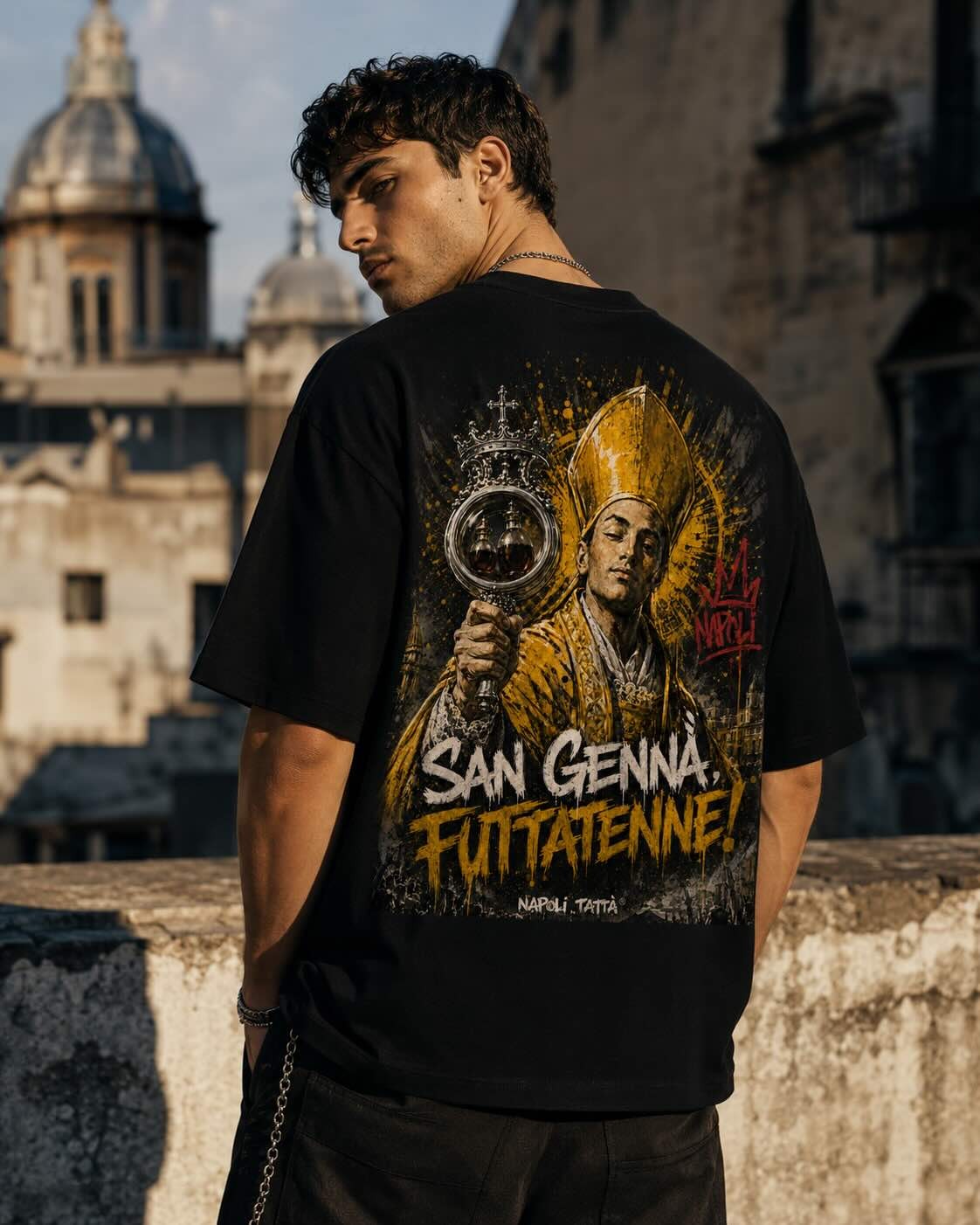 San Gennà, futtatenne! (Saint Januarius, don't worry about it!) San Gennaro, 19 September and the patron saint's t-shirtRead more
Who San Gennaro was, the miracle of the blood that liquefies, and the feast on 19 September. Plus that close,...
-
 'O purpo se coce int'a ll'acqua soja: what it means (o purpo se coce meaning)Read more
Someone's wronged you, and instead of reacting, you wait in silence with a smile? Here's the Neapolitan proverb that...
-
 Cazzimma: meaning, origin and why it's untranslatableRead more
There's a word that explains everything in Naples, and it can't be translated into any language. It's called...
-
 Who is Minollo? Totoro speaks NeapolitanRead more
He's not an animal, and he wasn't born in Naples. But like everyone who passes through here, he stayed.
-
 Oilloc', oiccann', oillann': what they mean and how to use themRead more
Three words for «there it is» at three different distances. Neapolitan has a grammar that Italian doesn't.
-
Neapolitan t-shirts with dialect phrases: the best ones (and what they really mean)Read more
Every Neapolitan phrase is a little portable theatre: a punchline, a philosophy, sometimes an affectionate threat....
-
 McFratm, the T-shirt dedicated to Scott McTominayRead more
The new T-shirt from Napoli Tattà dedicated to Scott McTominay, Napoli's midfielder wearing the number 8 shirt
-
 "Sono napoletano, orgoglioso del mio vulcano", the new chant of Napoli's fansRead more
"Sono napoletano, orgoglioso del mio vulcano" (I'm from Naples, proud of my volcano), the new chant of Napoli's fans...
-
 Iglesia Maradoniana (The Church of Maradona)Read more
Iglesia Maradoniana (The Church of Maradona), a parody religion founded by supporters of the former Argentine...
Blog categories
Search in blog
Chi chiagne fotte a chi ride: what it means and why it's truer than ever
Picture the scene: you're at the till in an office, you've been waiting in silence for half an hour, polite, with a smile plastered on your face. Then along comes someone who barges in huffing and puffing, raises their voice, complains about everything and everyone… and gets served before you. In that moment, deep down, a little Neapolitan voice whispers an ancient truth: chi chiagne fotte a chi ride ("he who cries cons him who smiles").
It's one of those proverbs we in Naples know before we can even walk. Cynical? Maybe. But anyone who's ever survived a queue, a negotiation or a residents' meeting knows that, nine times out of ten, that's exactly how it works.
What "chi chiagne fotte a chi ride" means
Translated literally: "he who cries cheats him who laughs." The meaning lies in a small, ruthless philosophy of life: those who complain, who play the victim, who show suffering (real or fake) get more than those who stay quietly smiling and say nothing.
The proverb captures a universal human dynamic: whoever protests loudly attracts attention, sympathy and advantages; whoever accepts everything calmly is often taken for granted. Mind you, it's not a celebration of playing the victim: it's more a bitter, wryly amused observation, a thoroughly Neapolitan way of saying "that's how the world works, let's keep that in mind."
It should be used with a touch of irony. When you say it, you're not really inviting someone to whinge: you're pointing out, with a half-smile, that whoever complained got the result. It's a compliment when you recognise someone's cunning; it's gentle criticism when you realise that you, ever the quiet one, went home empty-handed.
Where it comes from
Like so many Neapolitan proverbs, this expression has no "birth certificate" or precise author: it's popular wisdom passed down by word of mouth, generation after generation, in the alleyways, the shops and the kitchens.
The most common theory is that it grew out of everyday observation of street life and trade: in a city that has historically always been crowded, where getting something often meant knowing how to bargain, whoever showed need and insistence secured better terms. The verb chiagnere (to cry) should be understood broadly here: to complain, to protest, to play the part of the one who's worse off.
Some say the proverb also reflects a certain Neapolitan fatalism, that ability to read power dynamics with disenchanted clarity. But these are, of course, just interpretations: the beauty of folk sayings is precisely that they belong to everyone and to no one, and no one can claim to have invented them.
How "chi chiagne fotte a chi ride" is used
Here are a few examples so you can bring it out with the right cadence:
- "Hê visto? S'è lamentato mez'ora e l'hanno cagnato 'o telefono gratis. Chi chiagne fotte a chi ride!" (Did you see? He complained for half an hour and they replaced his phone for free. He who cries cons him who smiles!)
- "Io stongo zitto e bbuono e nun ottengo maje niente. Aggia 'mparà a chiagnere pur'io." (I keep quiet and never get anything. I need to learn to complain too.)
- "Nun te fà truvà semp'accussì gentile, ca chi chiagne fotte a chi ride." (Don't always be so polite, because he who cries cons him who smiles.)
- "Muglierema ha fatto 'na faccia 'e sofferenza e 'o capo l'ha dato 'e fferie ca vuleva. Overo, chi chiagne fotte a chi ride." (My wife pulled a suffering face and the boss gave her the holiday days she wanted. It's true, he who cries cons him who smiles.)
And a little dialogue, the kind you hear at the bar:
- "Ma comme, tu ê avuto 'o sconto e io no?" (How come you got the discount and I didn't?)
- "Embè, tu ririve e io me lamentavo. Chi chiagne fotte a chi ride, caro mio!" (Well, you were laughing and I was complaining. He who cries cons him who smiles, my dear!)
Why we put it on a T-shirt
Because this proverb is Naples in five words: irony, realism and that knack for laughing at life's unwritten rules. It's never pure spite; it's cunning told with a crooked smile, the same one you hear when someone says it while shaking their head.
We liked the idea of wearing it as a little statement of philosophy: a reminder for our quiet friends who should stand up for themselves more, and a knowing wink to those who've already worked out how the world turns. That's why we designed with love the ‘Chi chiagne fotte a chi ride’ T-shirt, for anyone who wants to wear a little piece of Neapolitan wisdom without having to explain too much.
It's the perfect piece to put on when you're going to negotiate something, or simply when you want to remind yourself that a little bit of complaining is fine every now and then. With elegance, of course, and always with that half-smile that's never in short supply in Naples.
If you liked this saying, know that there are plenty more just waiting to be told. Take a look at our range dedicated to Naples and dialect and find the proverb that suits you best.
Posted in:
Neapolitan Spirit
Related posts
-
San Gennà, futtatenne! (Saint Januarius, don't worry about it!) San Gennaro, 19 September and the patron saint's t-shirt
Who San Gennaro was, the miracle of the blood that liquefies, and the feast on 19 September. Plus that close,...Read more
-
'O purpo se coce int'a ll'acqua soja: what it means (o purpo se coce meaning)
Someone's wronged you, and instead of reacting, you wait in silence with a smile? Here's the Neapolitan proverb that...Read more
-
Cazzimma: meaning, origin and why it's untranslatable
There's a word that explains everything in Naples, and it can't be translated into any language. It's called...Read more
-
 “Figlio Velato” (Veiled Son), Church of San Severo
"The magnificent sculpture, carved from a single block of fine marble, depicts a child wrapped in a delicate veil,...Read more
“Figlio Velato” (Veiled Son), Church of San Severo
"The magnificent sculpture, carved from a single block of fine marble, depicts a child wrapped in a delicate veil,...Read more -
 Mamma d' 'o Carmene
But why is this Virgin so beloved by the Neapolitan people? What wonders do they reveal to us? To find out, we need...Read more
Mamma d' 'o Carmene
But why is this Virgin so beloved by the Neapolitan people? What wonders do they reveal to us? To find out, we need...Read more
Leave a comment