
Who San Gennaro was, the miracle of the blood that liquefies, and the feast on 19 September. Plus that close,...

Free shipping in Italy
On the entire catalogue. Delivery within 3 working days, with international shipping available at checkout.

5,000+ Customers

4,6/5 su Facebook
La valutazione vera della nostra pagina, 147.000 follower. Leggi le recensioni.

Pay in 3 or more instalments
Latest posts
-
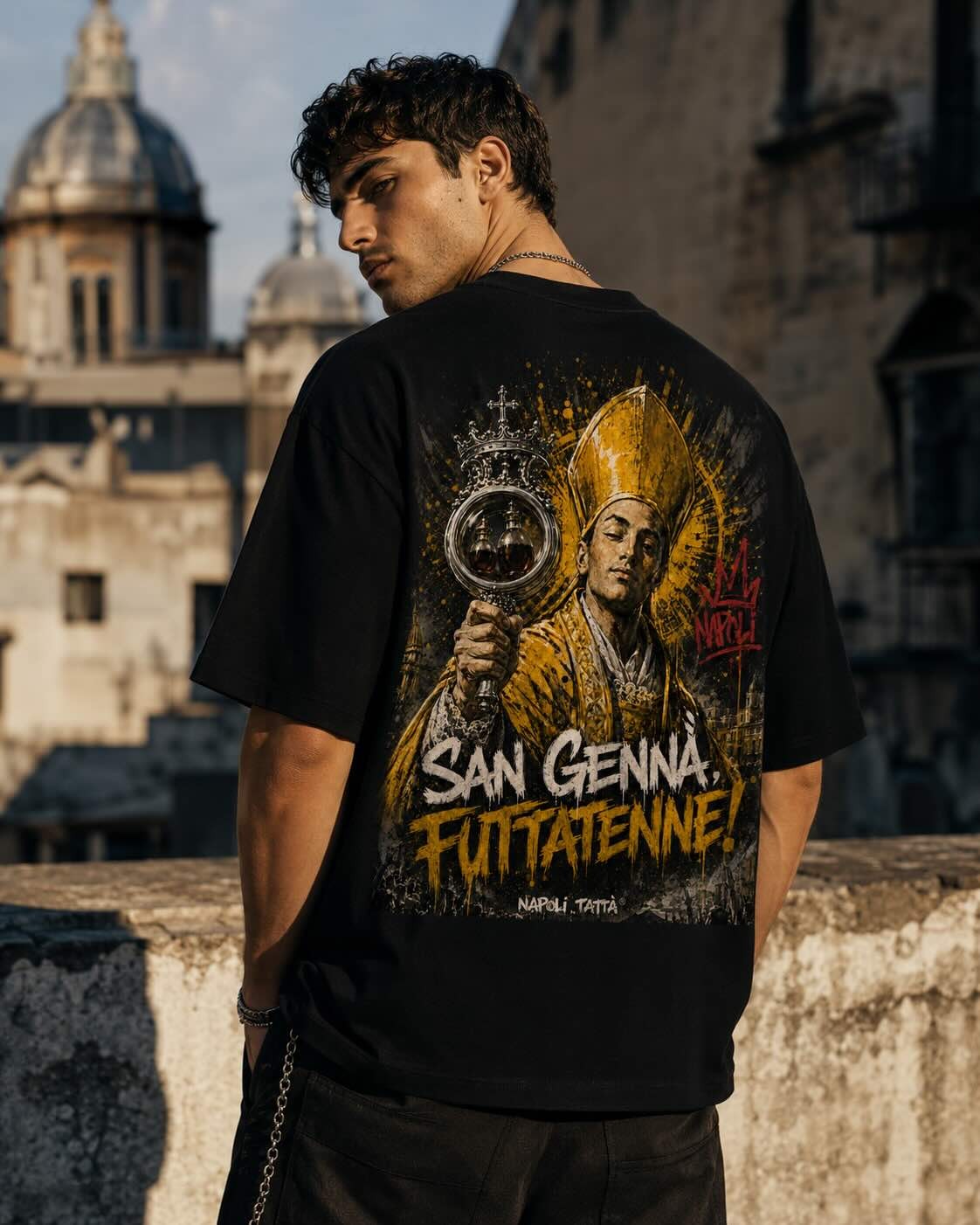 San Gennà, futtatenne! (Saint Januarius, don't worry about it!) San Gennaro, 19 September and the patron saint's t-shirtRead more
 -
 'O purpo se coce int'a ll'acqua soja: what it means (o purpo se coce meaning)Read more
Someone's wronged you, and instead of reacting, you wait in silence with a smile? Here's the Neapolitan proverb that...
-
 Cazzimma: meaning, origin and why it's untranslatableRead more
There's a word that explains everything in Naples, and it can't be translated into any language. It's called...
-
 Who is Minollo? Totoro speaks NeapolitanRead more
He's not an animal, and he wasn't born in Naples. But like everyone who passes through here, he stayed.
-
 Oilloc', oiccann', oillann': what they mean and how to use themRead more
Three words for «there it is» at three different distances. Neapolitan has a grammar that Italian doesn't.
-
Neapolitan t-shirts with dialect phrases: the best ones (and what they really mean)Read more
Every Neapolitan phrase is a little portable theatre: a punchline, a philosophy, sometimes an affectionate threat....
-
 McFratm, the T-shirt dedicated to Scott McTominayRead more
The new T-shirt from Napoli Tattà dedicated to Scott McTominay, Napoli's midfielder wearing the number 8 shirt
-
 "Sono napoletano, orgoglioso del mio vulcano", the new chant of Napoli's fansRead more
"Sono napoletano, orgoglioso del mio vulcano" (I'm from Naples, proud of my volcano), the new chant of Napoli's fans...
-
 Iglesia Maradoniana (The Church of Maradona)Read more
Iglesia Maradoniana (The Church of Maradona), a parody religion founded by supporters of the former Argentine...
-
 Rose Villain wears the ironic t-shirt with the word “pret” at SanremoRead more
Rose Villain had a hilarious moment at the Sanremo Festival 2025: just before stepping on stage for her evening...
Blog categories
Search in blog
San Gennà, futtatenne! (Saint Januarius, don't worry about it!) San Gennaro, 19 September and the patron saint's t-shirt
In Naples, San Gennaro is no ordinary saint. He's family. He's the old uncle you ask for a favour and end up having a bit of a row with at the same time — the one you pray to on your knees and then tell off when things go wrong. It's a relationship with nothing formal about it: pure familiarity, built on blind faith and healthy resignation. And it's exactly from here that "futtatenne" is born — literally "don't give a damn about it", let it go, don't think about it — a phrase the people of Naples know how to say like a secular prayer, a survival philosophy disguised as an affectionate curse.
Before we get to the t-shirt, though, let's settle in. Because the story of San Gennaro deserves to be told properly, without rushing and without postcard-saint clichés.
Who San Gennaro really was
There are few certain facts about his life, and anyone who tells you otherwise is embroidering the truth. What the historical sources give us is essential but powerful: Gennaro was Bishop of Benevento and was martyred during the persecution of Emperor Diocletian. His story begins with an act of friendship: Gennaro goes to visit Sossio, deacon of Miseno, who had been arrested by order of Dragonzio, governor of Campania.
With him are the deacon Festus and the reader Desiderius. The three publicly intercede for their imprisoned friend and declare themselves Christians: as a result, they too are arrested. The first sentence was the kind designed to make a spectacle — being torn apart by bears in the amphitheatre of Pozzuoli — but fearing that the crowd, who sided with the condemned men, might riot, the governor opted for a more discreet death: beheading. Gennaro was beheaded near the Solfatara of Pozzuoli, traditionally on 19 September 305 AD. That date is no small detail: it's recorded as the day of his martyrdom in extremely ancient documents, from the Carthaginian Calendar to the Hieronymian Martyrology and the Marble Calendar of Naples.
How Naples claimed its saint
Gennaro was from Benevento, died in Pozzuoli, and yet he's Neapolitan to the core. Why is that? The answer lies in the journeys of his relics. Between 413 and 431, the Bishop of Naples, John I, transferred the saint's remains to the catacombs of Capodimonte, which took his name from that moment on. His remains then made other journeys — Benevento, the Abbey of Montevergine — before finally coming home for good. Today the saint's skull and the two vials of blood are kept in Naples Cathedral, and it's there, every year, that the miracle takes place which holds an entire city's breath.
San Gennaro, 19 September: the blood miracle and the feast
Let's take a step back. According to tradition, during the martyrdom a noblewoman named Eusebia collected some of the bishop's blood in two vials. It's that same blood — clotted, dark, solid for over sixteen hundred years — that three times a year turns liquid again before the eyes of thousands of the faithful. The earliest written record of the liquefaction dates back to a 1389 document, the Chronicon Siculum.
The three dates are no coincidence, and each has its own meaning:
- The Saturday before the first Sunday of May, commemorating the first translation of the remains from Pozzuoli to the catacombs of Naples.
- 19 September, the anniversary of the martyrdom: this is the official feast, the main day, the one the whole city waits for.
- 16 December, in memory of the 1631 eruption of Vesuvius which, according to the faith of the Neapolitans, was halted through the saint's intercession.
The ritual is always the same, and every time feels like the first. After Mass, the archbishop opens the double-locked safe, takes out the crystal reliquary holding the two vials and shows it to the faithful, slowly turning it over every few seconds. The church holds its breath. Sometimes it takes just a few minutes, sometimes a whole hour, and sometimes — and here's where a chill runs down your spine — nothing happens at all. When the dark clot dissolves and bubbles back to bright red, the signal is given: the white handkerchief is waved, there's applause, eyes well up. And, according to tradition, twenty-one cannon shots from Castel dell'Ovo announce it to the whole city.
"Futtatenne": the Neapolitan theology of the family saint
Here's the point that explains everything. For Neapolitans, the timing and intensity of the liquefaction are a good omen; a delay, or — heaven forbid — the blood failing to liquefy at all, is read as an unfavourable sign for the city. This is where the relationship with the patron saint becomes something unique in the world: he's prayed to, he's implored, and if he plays up, he gets told off too. The famous "parenti di San Gennaro" (San Gennaro's relatives), women of unshakeable faith, can go from the most heart-rending litany to the bluntest telling-off within a single sentence.
Because Neapolitans keep no distance from the sacred: they live alongside it. And "futtatenne" is the exact flip side of this devotion. It isn't indifference, it's ancient wisdom: faced with what you can't control — work, fate, Vesuvius, the traffic in Fuorigrotta — you learn not to let it eat you alive. San Gennaro watches over you, you do your part, and for the rest, well, futtatenne. It's a caress and a superstitious way of shrugging off the weight of the world. A way of saying: he'll take care of it, and if he doesn't, we'll manage anyway.
The patron saint's t-shirt: "San Gennà, futtatenne!"
From this weave of faith, irony and everyday resilience comes our Limited Edition "San Gennà, futtatenne!" t-shirt. It isn't a t-shirt with a holy picture printed on it: it's a piece of that Neapolitan philosophy that knows how to kneel and stand tall at the same time, that prays and makes light of things, that has faith without taking itself too seriously. Wearing it is like carrying a piece of Naples with you, and its close familiarity with heaven.
And if you want to declare your bond with the patron saint even more directly, there's also the unisex "Dincello a San Gennaro" t-shirt — meaning "tell San Gennaro about it", that is, put your trust in him, commend yourself to him, leave it in his hands. Two different ways of telling the same slightly cheeky love for the saint of the house.
Whether you're one of those who hold their breath in front of the vials on 19 September, or one of those who follow the miracle from afar but believe in it just as much in their heart, this is the t-shirt that speaks your language. Make it yours, wear it with that half-devout, half-cheeky smile that only we know how to pull off, and remember the most Neapolitan lesson of all: pray, hope, and for the rest, futtatenne. Take a look at the Limited Edition dedicated to San Gennaro: San Gennaro watches over the city, we watch over your wardrobe.
Posted in:
Neapolitan Spirit
Related posts
-
'O purpo se coce int'a ll'acqua soja: what it means (o purpo se coce meaning)
Someone's wronged you, and instead of reacting, you wait in silence with a smile? Here's the Neapolitan proverb that...Read more
-
Cazzimma: meaning, origin and why it's untranslatable
There's a word that explains everything in Naples, and it can't be translated into any language. It's called...Read more
-
 “Figlio Velato” (Veiled Son), Church of San Severo
"The magnificent sculpture, carved from a single block of fine marble, depicts a child wrapped in a delicate veil,...Read more
“Figlio Velato” (Veiled Son), Church of San Severo
"The magnificent sculpture, carved from a single block of fine marble, depicts a child wrapped in a delicate veil,...Read more -
 Mamma d' 'o Carmene
But why is this Virgin so beloved by the Neapolitan people? What wonders do they reveal to us? To find out, we need...Read more
Mamma d' 'o Carmene
But why is this Virgin so beloved by the Neapolitan people? What wonders do they reveal to us? To find out, we need...Read more -
 The 1944 Vesuvius Eruption
On 6 January 1944, a crack appeared on the flank of the Vesuvius crater, causing an increase in lava flow. This...Read more
The 1944 Vesuvius Eruption
On 6 January 1944, a crack appeared on the flank of the Vesuvius crater, causing an increase in lava flow. This...Read more
Leave a comment