



In Naples, a graduation is never a private affair: it's a neighbourhood celebration. Here's how to choose an original...
Latest posts
-
 Original Neapolitan graduation gift: ideas for the graduate (him and her)Read more
-
 Asso 'e mazze: meaning and history of the Neapolitan ace of clubsRead more
The strongest card on the green table becomes, in Naples, the most elegant way to say who really calls the shots....
-
 Michelina Di Cesare, the brigantessa who defied a kingdomRead more
Born poor in Terra di Lavoro, Michelina Di Cesare chose the maquis and the rifle against a newly united Italy. A...
-
 Neapolitan Hoodies: The Autumn 2026 Style GuideRead more
When the air turns crisp, in Naples people don't just reach for a hoodie: they reach for a piece of identity. Here's...
-
 Maradona Stadium: City Council allocates €50 million for Euro 2032Read more
The City Council has allocated €50 million for the redevelopment of the Diego Armando Maradona stadium, ahead of...
-
 Pizza Maxima 2026: Franco Pepe Is Once Again Best Pizzeria in ItalyRead more
At the fifth edition of Pizza Maxima, the Oscars of Italian pizza, Franco Pepe confirms his title as Best Pizzeria in...
-
 ‘L’acqua è poca e ‘a papera nun galleggia’: what it meansRead more
When the means are few, so is the result. Let's discover the most realistic Neapolitan saying there is.
-
 Avanti Scugnizzi: the story of the year's most loved T-shirtRead more
One word, ‘scugnizzo’ (Neapolitan street kid), and it holds the whole of Naples inside it. We tell you how the year's...
-
 'Chi chiagne fotte a chi ride': what it means and why it's truer than everRead more
At the market, at the counter, in the family: there's always someone who complains and gets more. It's the sharp...
-
 San Gennà, futtatenne! (Saint Januarius, don't worry about it!) San Gennaro, 19 September and the patron saint's t-shirtRead more
Who San Gennaro was, the miracle of the blood that liquefies, and the feast on 19 September. Plus that close,...
Blog categories
Search in blog
Archived posts
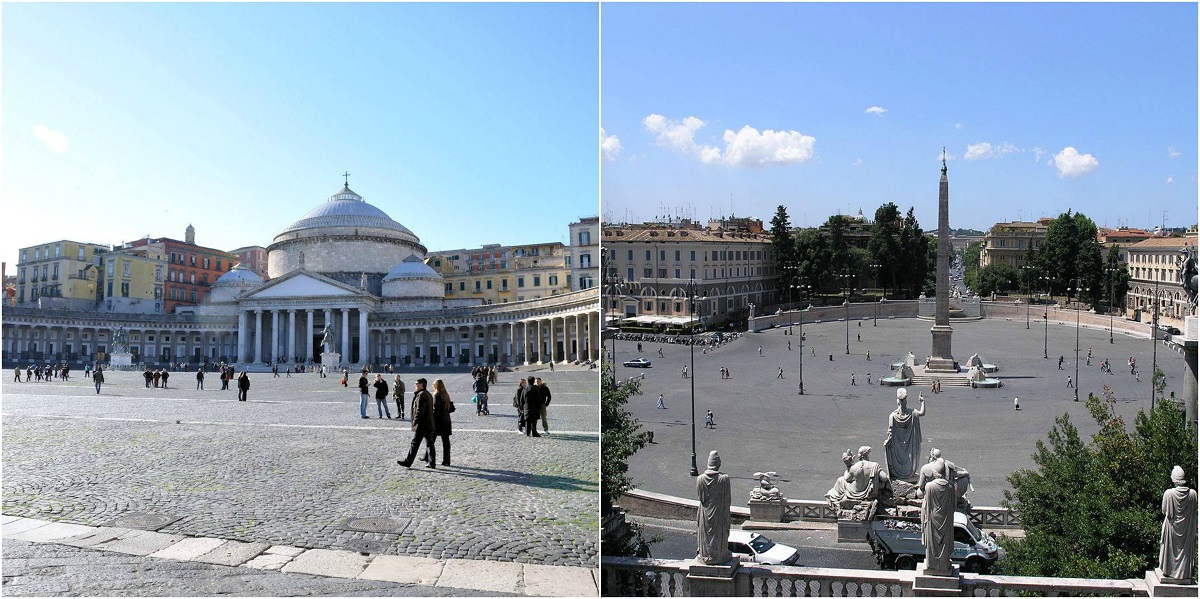
Naples VS Rome
Naples and Rome are two great cities, where you can truly find it all, from good food to monuments, from traditional songs to typical restaurants. We've compared the two metropolises through ten of these characteristics.
by Alessia Giannino
Naples and Rome are two great cities, where you can truly find it all, from good food to monuments, from traditional songs to typical restaurants.
We've compared the two metropolises through ten of these characteristics.
1 - Piazza del Plebiscito / Piazza del Popolo
Piazza del Plebiscito is one of the symbols of Naples. Over the centuries it has changed enormously: from a simple stretch of countryside, where medieval jousting tournaments were held, it has become the gathering place of the Neapolitans, and often hosts shows and concerts too. It is the city's main square, and tourists from all over the world walk through it to admire its beauty. Here you'll find no fewer than two jewels: the Royal Palace, built in 1500, and the colonnade of the Church of San Francesco di Paola.
Rome's counterpart to this place is Piazza del Popolo, which represents Renaissance papal patronage, the setting of popular games and shows, but also of capital executions. Today it is a place people pass through on their way to Via del Corso or up to the Pincio. In the square there are two twin churches: Santa Maria di Montesanto and Santa Maria dei Miracoli. In the centre, meanwhile, stands the Flaminio Obelisk and the two Valadier fountains, which certainly make it even more beautiful.
2 - Genovese / Carbonara
Genovese, along with Ragù, is one of the classic dishes of Neapolitan culinary tradition, made mainly with meat and onions. There are several legends explaining its name. It's said that in the port area of Naples there were countless taverns where a dish of meat and onion was prepared to feed the Genoese sailors who arrived in Naples on their ships. Another version links the dish's name to the origin of the taverns' cooks, who were supposedly actually from Genoa. Yet another story attributes the dish to the genius of a Neapolitan cook nicknamed ‘O genovese (the man from Genoa). No one knows which story is true, but it's certainly a dish born in a humble setting.
As for Roman Carbonara, its origins are still uncertain: there's no trace of it in Ada Boni's famous early-20th-century recipe book. It seems, in fact, to be a recipe of American origin. During the Second World War, in Italy, the Gustav Line was set up to slow the enemy's advance. In the Apennines, meanwhile, a group of young Americans was stationed, and there they found, it's said, eggs, cheese and smoked bacon. They were struck by a deep longing for home comforts and breakfast. It's said that by combining these ingredients, they created the very first carbonara. The recipe then made its way to Rome, where it became a tradition.
3 - Nennella / La Parolaccia
There isn't a single Neapolitan who hasn't, at least once in their life, eaten at the famous Trattoria Nennella, to soak up an entirely homely atmosphere and enjoy traditional Neapolitan dishes, with a menu that changes with the seasons. Pasta e patate (pasta and potatoes) is one of the must-haves, but fish dishes and homemade desserts are also on offer. One of the trattoria's quirks is precisely this “familiarity” shown to diners. It's a bit like being at home, so much so that, every now and then, a rather colourful word or two might "fly" your way. Plenty of warmth and excellent food, in short.
A similar spot on the Roman side is “Cencio la Parolaccia” (Cencio the Swear Word), which has been serving traditional Roman dishes for decades now. Initially it was just a restaurant, then the owners decided to bring in actor Massimo Serato and combine dining with entertainment. Today the restaurant is famous for the insults and swear words hurled at customers by the staff and the host.
4 - Lungomare / Lungotevere
The Naples seafront (Lungomare) is the most beautiful in the world. You daydream, you stroll along gazing at the Mediterranean and a wonderful landscape. The promenade is separated from the sea only by some artificial rocks, which have taken the place of the ancient beaches, of which only a few fragments remain near the roundabouts. There's nothing else quite like it.
In Rome, locals and tourists can stroll along the Lungotevere, which is certainly romantic and enchanting, but, at least in the eyes of a true-born Neapolitan, it doesn't match up to the Naples seafront.
5 - The Ruins of Pompeii / The Roman Forum
World-famous, the archaeological excavations of Pompeii have brought to light the remains of the ancient city, buried under ash and lapilli during the eruption of Vesuvius in 79 AD, along with Herculaneum, Stabiae and Oplontis. The findings from the excavations represent some of the best evidence of Roman life, as well as the best-preserved city of that era. Most of the recovered artefacts are frescoes, statues and mosaics, now kept in the National Archaeological Museum of Naples and the Antiquarium of Pompeii.
Rome, too, has the remains of a city now buried. The Roman Forum is an archaeological area enclosed between the Palatine Hill, the Capitoline Hill, Via dei Fori Imperiali and the Colosseum, comprising layer upon layer of remains of hugely important buildings and monuments from Rome's ancient history: the site was, in fact, the political, legal, religious and economic centre of the city, as well as the nerve centre of the entire Roman civilisation. From the regal era right through to the Middle Ages, the Forum valley was the setting for events and the seat of institutions of great importance. After a period of decline that began in late antiquity, the Forum underwent various changes of use, until, by the 16th century, it was almost entirely buried and used as grazing land for cattle (hence the nickname Campo Vaccino, or Cow Field). Later, once Italy was unified, interest in the Forum grew until it culminated in an urban restoration project that brought it back to light, studied and turned into a museum.
6 - Neapolitan Song / Popular Roman Song
Classic Neapolitan Song encompasses the repertoire spanning from the early 19th century to the years right after the Second World War. It represents one of the finest achievements in Italian song, so much so that, over the years, it has become a symbol of Italian music worldwide. The songs of that era have, over time, been performed by numerous world-famous singer-songwriters, who have helped spread them far and wide. Who could forget, for instance, Enrico Caruso, Roberto Murolo, Placido Domingo, José Carreras, Elvis Presley, Dean Martin, Andrea Bocelli, Claudio Villa, Al Bano, Lucio Dalla, Renato Zero, Domenico Modugno, Elton John, Ella Fitzgerald, Nina Simone, Frank Sinatra, Paul McCartney, Luciano Pavarotti, Celine Dion, and so many, many others.
Popular Roman Song is certainly older than its Neapolitan counterpart, but also less well known. Its roots go back as far as the mid-Middle Ages, reflecting the mindset, customs, beliefs, needs and desires of the time. Naturally, as the centuries passed, the songs transformed and took on different meanings.
7 - Castel dell'Ovo / Castel Sant'Angelo
Castel dell'Ovo (Egg Castle) is the oldest castle in the city of Naples and one of the features that stands out most in the gulf. Its original Norman appearance has changed due to various events, so that today it looks very different from how it was originally conceived. Its name comes from an ancient legend, according to which the poet Virgil hid, deep in its dungeons, an egg that kept the entire fortress standing. Should the egg break, so the legend goes, not only would the castle collapse, but the city of Naples itself would meet its end.
Rome, too, has its own castle, though it has had an unusual fate within the city's artistic landscape: while of all the other Roman-era monuments we're left with only ruins, of Castel Sant'Angelo we have the entire building. From funerary monument to fortified outpost, from a dark and terrible prison to a splendid Renaissance residence, from a Risorgimento-era jail to a museum, the castle embodies, within its mighty walls and lavishly frescoed halls, the whole story of the Eternal City.
8 - Spaccanapoli / Via del Corso
The lower decumanus of Naples is also known as Spaccanapoli (literally, "Naples-splitter") and is the street that divides the city in two.
It is one of the most important arteries of the Historic Centre. Between the Middle Ages and the 19th century, it grew in importance both for the convents of religious orders and for the homes of the powerful men who lived there. Today it's a destination for tourists from all over the world and a daily thoroughfare for people of all ages crossing from one side of the centre to the other.
Just as Spaccanapoli is to the Neapolitan city, so Via del Corso, in Rome, is one of the city's main streets. 1.6 km long, it connects Piazza Venezia to Piazza del Popolo. Today, along the street, stand noble palazzos, churches and, of course, countless shops.
9 - Attanasio's Sfogliatella / Pompi's Tiramisù
The scent of Attanasio's sfogliatella can't be put into words: it strikes the heart and devastates it beyond repair. There's nothing better, and anyone passing through Naples simply has to stop by.
Attanasio is a small, almost century-old pastry shop tucked away in a little side street near the Central Station. The flavour and scent of this pastry remain, by tradition, always the same. A warm, soft, crispy sfogliatella is pure bliss.
This classic Neapolitan pastry can't really be compared to any "foreign" dessert, but as far as Roman tradition goes, one certainly worth mentioning is the famous Pasticceria Pompi, which calls itself the Kingdom of Tiramisù. Indeed, their version of this dessert is truly excellent, made in various flavours, such as strawberry, pistachio, hazelnut, and banana and chocolate. A delicate product, the result of 50 years of experience. In short, good, yes, but some would object: "not a patch on the Neapolitan sfogliatella".
10 - The Pedamentina Steps / The Spanish Steps
The Pedamentina steps are very famous in Naples: they consist of 414 steps connecting the Certosa di San Martino to Corso Vittorio Emanuele. This route was begun in the 14th century by architects Tino di Camaino and Francesco de Vito, but only later took on its current form. Today it stands as an important piece of historical and urban heritage; the Pedamentina is also fascinating from a scenic point of view, since it runs alongside the vegetable gardens and gardens of the nearby Certosa and offers, to those descending, a beautiful view over the Gulf of Naples.
Naples has the Pedamentina, Rome has the Spanish Steps. These consist of 135 steps, inaugurated by Pope Benedict XIII in 1725, on the occasion of the Jubilee: the staircase was built to connect the Spanish Bourbon embassy to the Church of Trinità dei Monti. The Spanish Steps have undergone various restorations over the years, the most recent of which was completed on 21 September 2016, thanks to a contribution from the fashion house Bulgari. Today it's a gathering place for tourists, but also for Romans themselves.
Posted in:
Places in Naples
Related posts
-
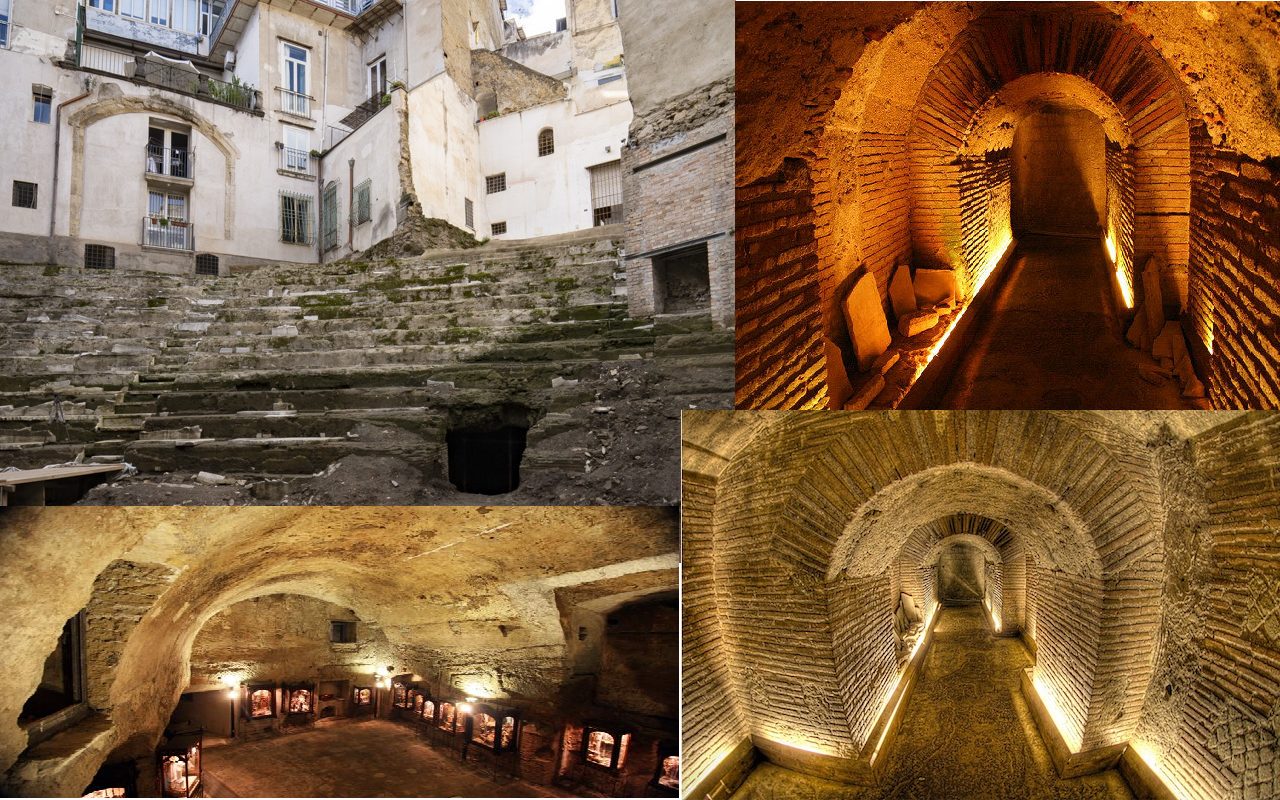 The Roman Theatre of Neapolis
Among the many wonders of Naples' historic centre stands the ancient Roman Theatre of Neapolis, between what are now...Read more
-
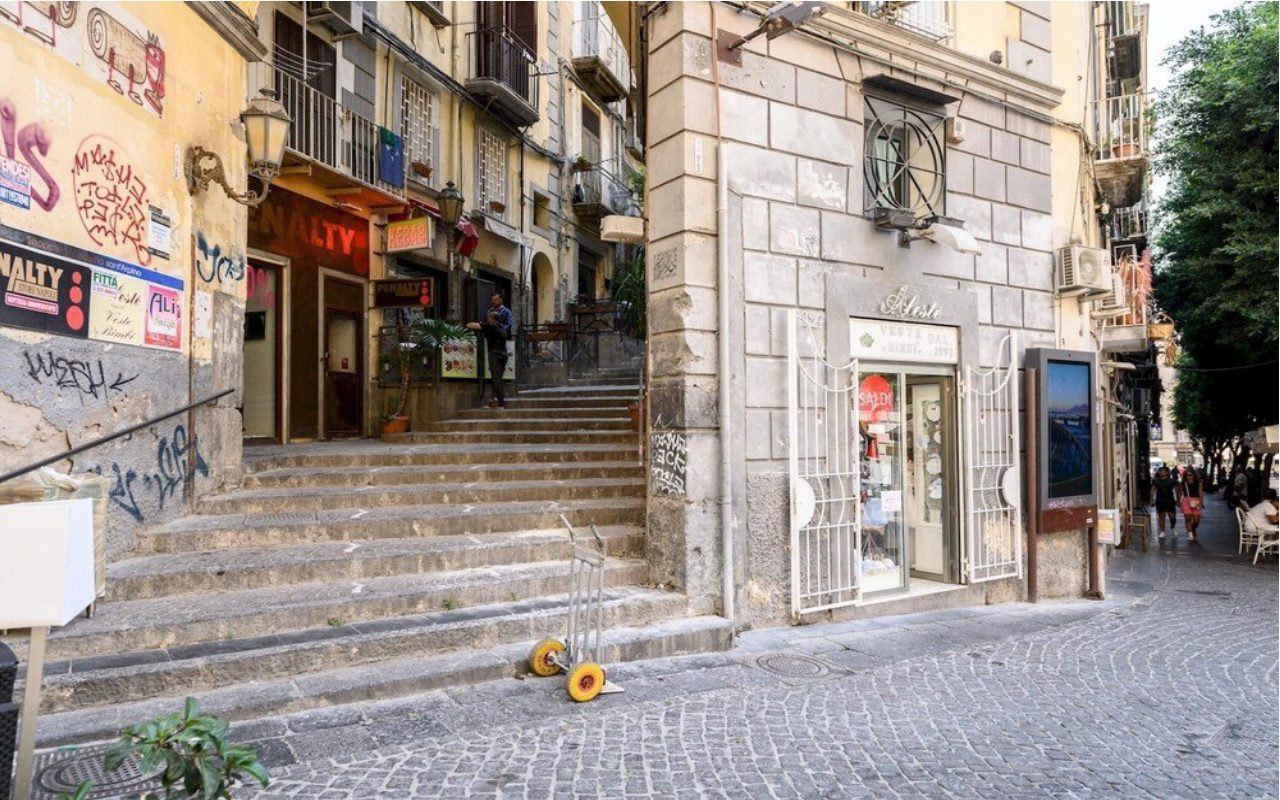 Discover Vicoletto Sant'Arpino: History and Beauty of Naples
There are corners of Naples that tell incredible stories, that take your breath away and make it unique, sincere and...Read more
-
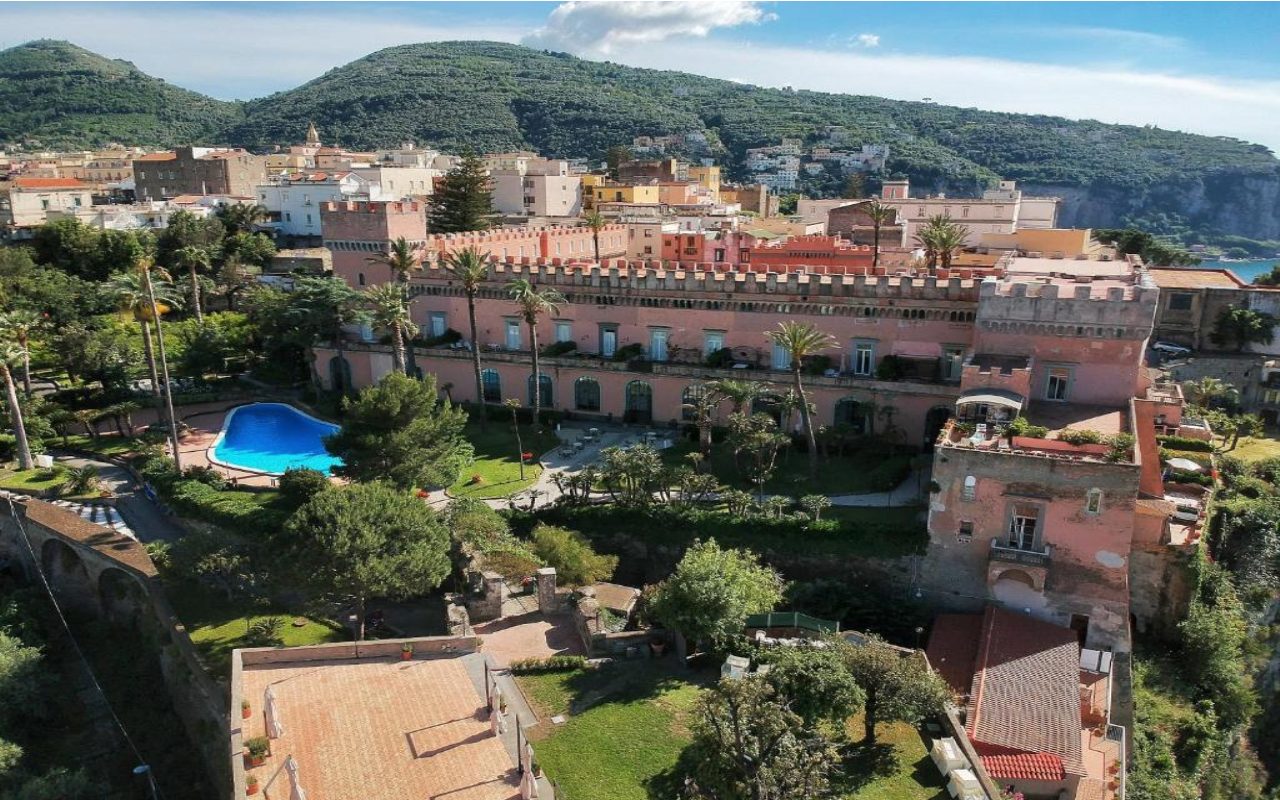 Giusso Castle: the legends of Vico Equense
Built at the end of the 13th century, Giusso Castle was designed as both a military fortress and a residence.Read more
-
 The apotropaic stone masks of lava rock and marble
Neapolitan apotropaic masks are truly fascinating works of art that can be admired on numerous historic buildings...Read more
-
 THE ROYAL PALACE OF CARDITELLO
The Tenuta Storica di Carditello (Historic Estate of Carditello), also known as the Reggia di Carditello (Royal...Read more
Leave a comment