



In Naples, a graduation is never a private affair: it's a neighbourhood celebration. Here's how to choose an original...
Latest posts
-
 Original Neapolitan graduation gift: ideas for the graduate (him and her)Read more
-
 Asso 'e mazze: meaning and history of the Neapolitan ace of clubsRead more
The strongest card on the green table becomes, in Naples, the most elegant way to say who really calls the shots....
-
 Michelina Di Cesare, the brigantessa who defied a kingdomRead more
Born poor in Terra di Lavoro, Michelina Di Cesare chose the maquis and the rifle against a newly united Italy. A...
-
 Neapolitan Hoodies: The Autumn 2026 Style GuideRead more
When the air turns crisp, in Naples people don't just reach for a hoodie: they reach for a piece of identity. Here's...
-
 Maradona Stadium: City Council allocates €50 million for Euro 2032Read more
The City Council has allocated €50 million for the redevelopment of the Diego Armando Maradona stadium, ahead of...
-
 Pizza Maxima 2026: Franco Pepe Is Once Again Best Pizzeria in ItalyRead more
At the fifth edition of Pizza Maxima, the Oscars of Italian pizza, Franco Pepe confirms his title as Best Pizzeria in...
-
 ‘L’acqua è poca e ‘a papera nun galleggia’: what it meansRead more
When the means are few, so is the result. Let's discover the most realistic Neapolitan saying there is.
-
 Avanti Scugnizzi: the story of the year's most loved T-shirtRead more
One word, ‘scugnizzo’ (Neapolitan street kid), and it holds the whole of Naples inside it. We tell you how the year's...
-
 'Chi chiagne fotte a chi ride': what it means and why it's truer than everRead more
At the market, at the counter, in the family: there's always someone who complains and gets more. It's the sharp...
-
 San Gennà, futtatenne! (Saint Januarius, don't worry about it!) San Gennaro, 19 September and the patron saint's t-shirtRead more
Who San Gennaro was, the miracle of the blood that liquefies, and the feast on 19 September. Plus that close,...
Blog categories
Search in blog
Archived posts
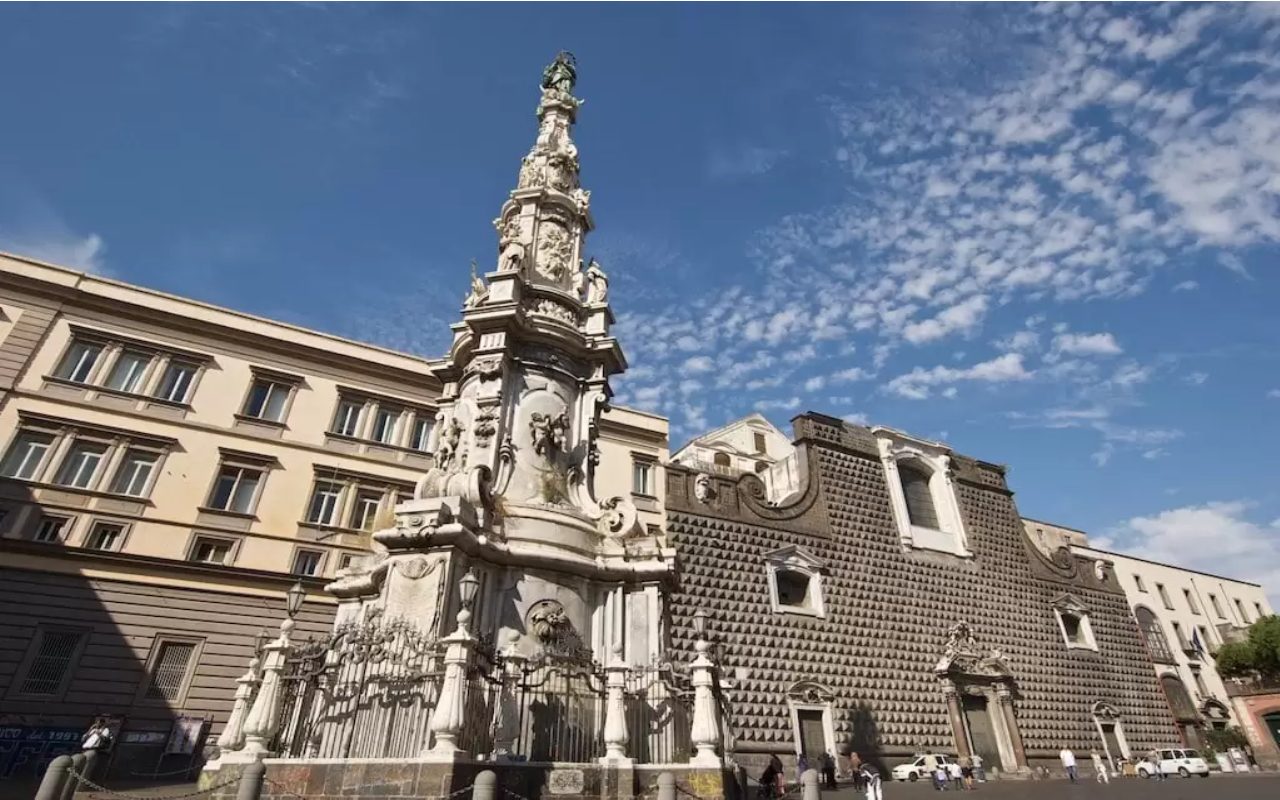
The spires of Naples
The spires of Naples speak of the affection and determination of the Neapolitan people in reaching up towards the heavens. A bell tower is, in fact, an architectural feature that rises upwards, usually pointed and slender. The spires of Naples are dedicated to the city's venerated saints: you can see them in some of the most significant squares; sometimes we walk past them without giving them a second thought — it's time to explore them with a little more curiosity!
There are five spires in Naples: the Spire of the Immaculate Conception, found in Piazza del Gesù Nuovo and in Materdei, the Spire of Saint Dominic, that of Saint Januarius and, finally, the Spire of Portosalvo. These monuments share an extremely Baroque style, and are therefore adorned with an abundance of statues, busts and sculpted reliefs.
°The Spire of the Immaculate Conception in Piazza del Gesù is one of two spires in Naples dedicated to the Immaculate Conception. Before 1707, the year Charles VI of Habsburg entered Naples, the site of the present monument was occupied by the equestrian statue of Philip V of Bourbon, created by Lorenzo Vaccaro in 1705 and destroyed two years later by the people. The current spire, 22 metres tall and made entirely of marble, was designed by Giuseppe Genuino, built by Giuseppe di Fiore, and completed in 1748. Its construction was funded through a public collection promoted by Father Francesco Pepe of the Society of Jesus, with the first stone laid by Bishop Lelio Carafa. The structure of the spire is richly decorated across several levels, set on a polygonal base. On the lowest level there are panels bearing inscriptions to the Virgin, while on the upper levels there are cherubs with biblical scenes and garlands of fruit. There are also four corner statues: Saint Ignatius, Saint Francis Xavier, Saint Francis Borgia and Saint John Francis Regis. The first two were made by Francesco Pagano, while the other two are by Matteo Bottigliero. Higher up, there are four bas-reliefs depicting the Nativity, the Annunciation, the Purification and the Coronation, all by Pagano and Bottigliero. There are also two medallions by Pagano himself with the busts of Saint Aloysius Gonzaga and Stanislaus Kostka. Finally, at the top of the spire stands a globe with the statue of the Immaculate Conception, made of gilded copper, also by Pagano.
° In the district with the meaningful name of ‘Madre di Dio’ (Mother of God), a monument dedicated to the Immaculate Conception could hardly be missing. In the past, the spire stood in the cloister of the former convent of the Church of the Conception in Materdei. However, what can be admired today in the small square is a faithful copy of the original, which after some restoration work was moved to the Civic Museum of Castel Nuovo. Among the various spires of Naples, the Immaculate Conception spire of Materdei is distinguished by having the oldest statue. It is believed to have been made by Domenico Gagini around 1470. The depiction of the Madonna shows a robe rich in folds, and at her side she holds the Christ Child, who in turn holds a book. On the other side of the statue, the Madonna holds a sphere, probably symbolising the Earth.
The Spire of the Immaculate Conception of Materdei is another of the wonderful spires of Naples that cannot go unnoticed. Standing at around 10 metres tall, the spire supports a beautiful statue of the Immaculate Conception, considered one of the oldest among the Neapolitan spires. The statue, probably the work of Domenico Gagini and datable to around 1470, depicts the Virgin holding the Christ Child and a sphere in her left hand. The pedestal, dating from the 18th century and attributed to Giuseppe Astarita, is an example of Neapolitan Baroque style. Made of white marble and piperno stone, it features soft, sinuous lines, imposing volumes and refined decoration. Although the origin of this monument is uncertain, there are various theories. Some believe the statue was originally kept inside Palazzo Sanseverino and was only later placed on the spire. Others believe it was already positioned in a chapel in the district and was later moved to the spire to further enhance it. Whatever the historical truth, the Spire of the Immaculate Conception of Materdei is certainly an unforgettable work of art in Naples.
°The Spire of San Domenico Maggiore is one of the most important among the spires of Naples, with a long and complicated history. Its construction dates back to 1656, when the people decided to erect the monument in thanks to Saint Dominic after the plague. The original design was created by Antonio Picchiatti, but work was halted in 1680 when the monument was only half-finished. Fifty years later, with the arrival of Charles of Bourbon, the Dominicans commissioned Domenico Antonio Vaccaro to complete the work according to Picchiatti's original design. The structure rises to around 26 metres and narrows towards the top. On the first tier there are two inscriptions and two busts depicting the siren Partenope, made by the master Cosimo Fanzago. Higher up, we find the coats of arms of the Order of Preachers, of the Royal House of Spain, the coat of arms of the city of Naples and that of the Viceroy Pietro Antonio d'Aragona. In the upper part of the spire, among the cherubs designed by Fanzago, there are medallions with reliefs portraying Saint Agnes, Pius V, the Blessed Margaret and Saint Vincent Ferrer. At the top, there are the effigies of Saint Hyacinth, Saint Peter Martyr, Saint Louis and Saint Raymond, together with further medallions of Saint Rose of Lima, Saint Thomas Aquinas, Saint Anthony and Saint Catherine. Vaccaro also created the design for the marble statue of Saint Dominic, although the sculptor of the statue itself remains uncertain.
°You find yourself in the square named after Cardinal Riario-Sforza, in the heart of Naples. Here stands the spire dedicated to Saint Januarius, which among the spires of Naples has the oldest history. It dates back to 1637 and was erected on the initiative of the Deputation of the Treasury of Saint Januarius, to thank the Saint for having protected the city during the eruption of Vesuvius in 1631. The construction of the spire was entrusted to the celebrated sculptor Cosimo Fanzago, who took nine years to complete it, finishing in 1660. The base of the pedestal houses four cherubs and a statue of the siren Partenope, holding a shield bearing the city's words of gratitude to the Saint. The obelisk, rising up towards the sky, is made up of a quadrangular column decorated with large scrolls ending in an Ionic capital adorned with winged cherubs. At the top stands the bronze statue of Saint Januarius, created by the sculptor Tommaso Montani. The Saint is depicted in a pose of blessing, holding the Gospel in his left hand, upon which rest the ampoules of his miraculous blood.
°The spire dedicated to Porto Salvo, one of the most recent among the spires of Naples, was erected in 1799 in Piazza Portosalvo to celebrate the victory won by the army of the Holy Faith and the Bourbon restoration following the experience of the Neapolitan Republic. The obelisk, made of piperno stone, has four faces and stands around eight metres tall. Each side features a Latin inscription running vertically from the base upwards, followed by an inset medallion and a sacred bas-relief scene. The intricate bas-reliefs, carved by the sculptor Angelo Viva, depict the saints who accompanied the Sanfedist army on their expedition, including the Madonna di Portosalvo (Our Lady of Portosalvo), Saint Januarius, Saint Anthony of Padua and Saint Francis of Paola (although the last image has been lost). The four medallions, strategically placed, depict the instruments of the Passion of Christ: the three nails of the cross, the Spear of Destiny, the Veil of Veronica and the Crown of Thorns. The Latin inscriptions carved on the faces of the obelisk bear the words of the sacred hymn Vexilla Regis (‘The Royal Banners’), which recalls the key moments of the Passion of Christ.
Posted in:
Places in Naples
Related posts
-
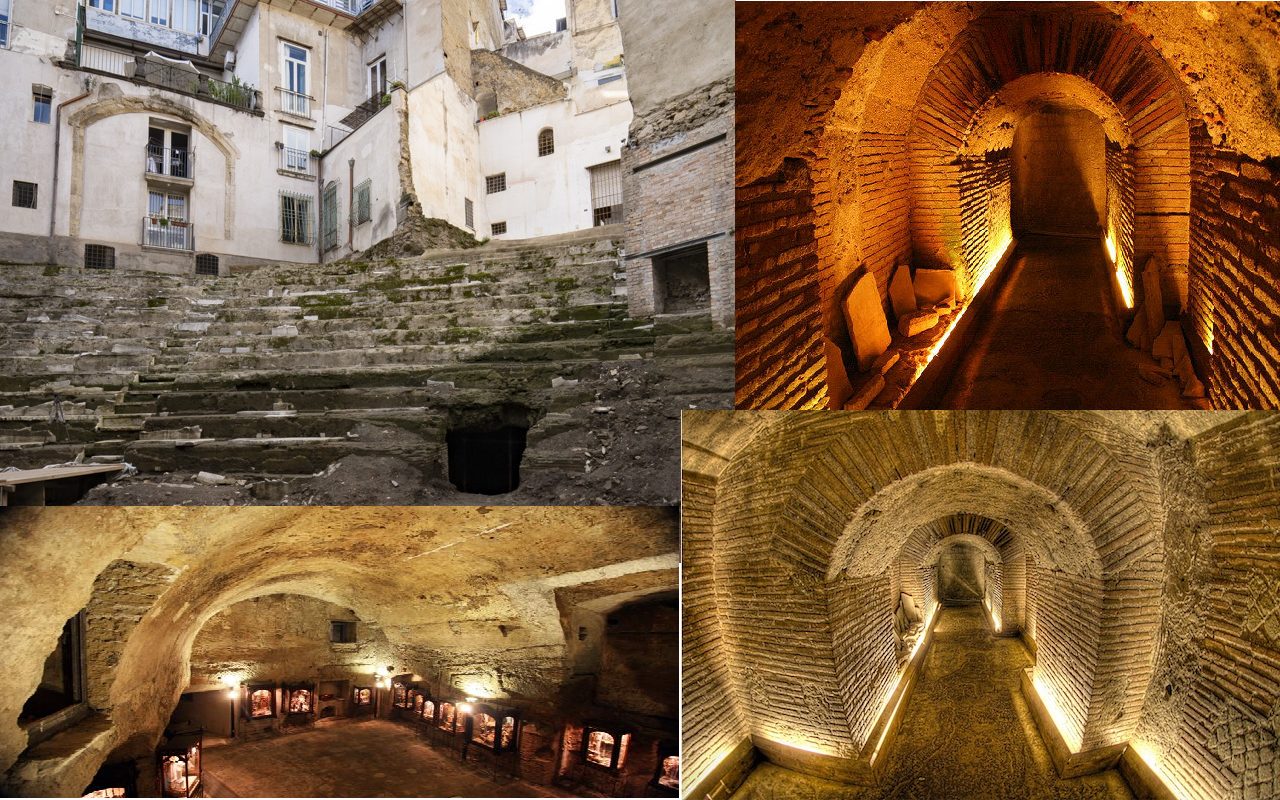 The Roman Theatre of Neapolis
Among the many wonders of Naples' historic centre stands the ancient Roman Theatre of Neapolis, between what are now...Read more
-
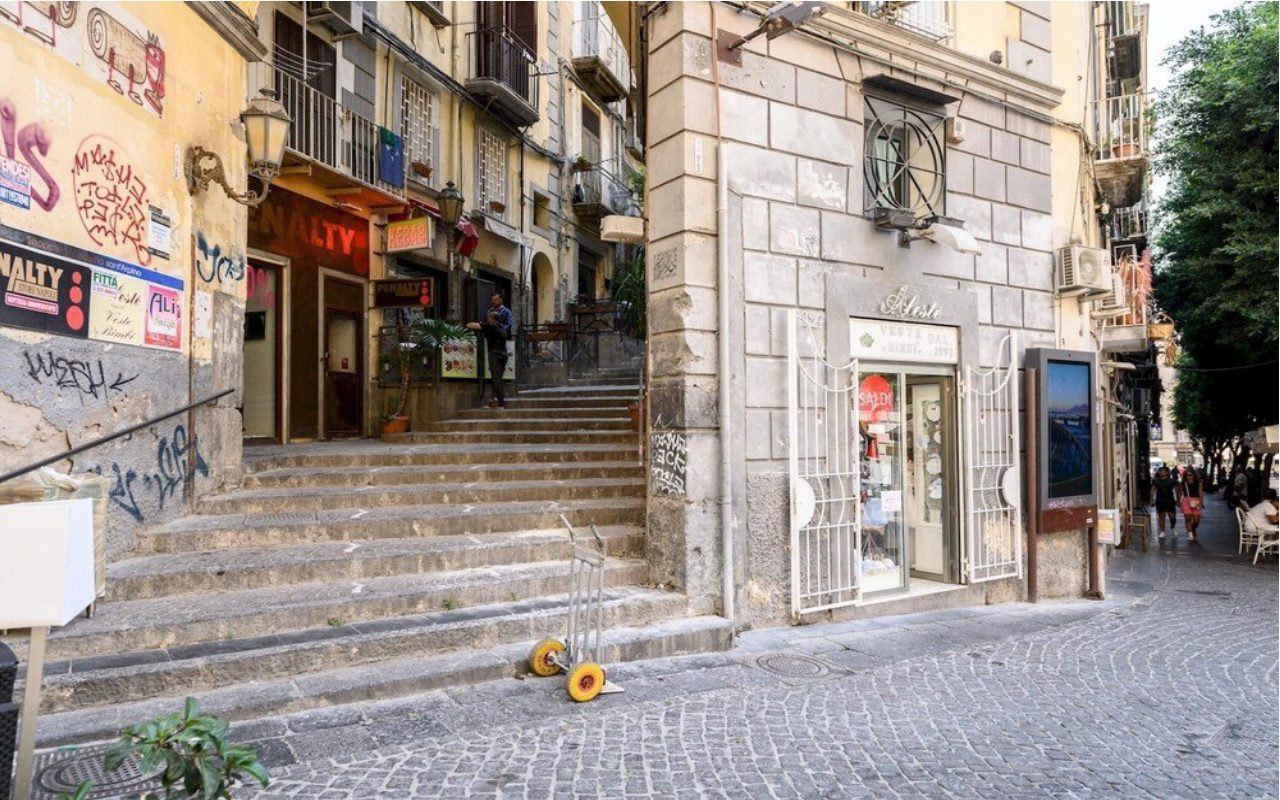 Discover Vicoletto Sant'Arpino: History and Beauty of Naples
There are corners of Naples that tell incredible stories, that take your breath away and make it unique, sincere and...Read more
-
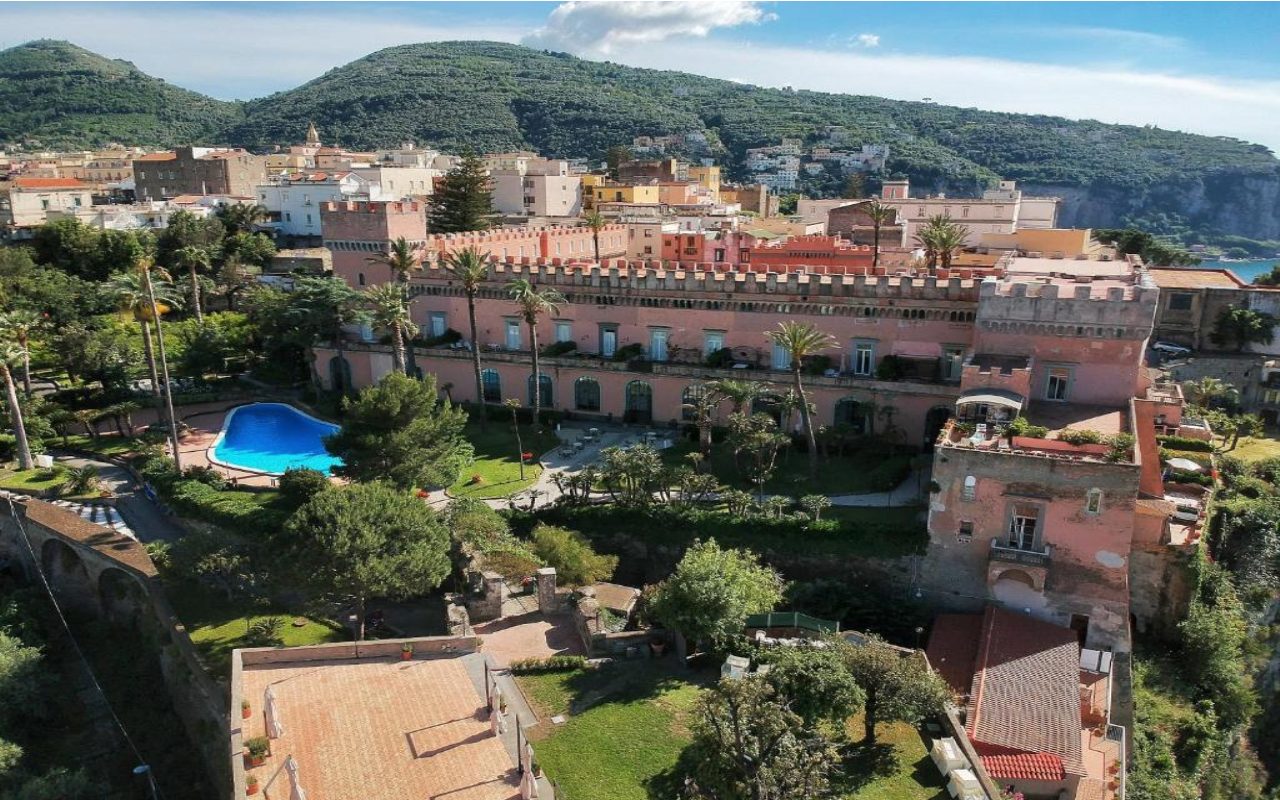 Giusso Castle: the legends of Vico Equense
Built at the end of the 13th century, Giusso Castle was designed as both a military fortress and a residence.Read more
-
 The apotropaic stone masks of lava rock and marble
Neapolitan apotropaic masks are truly fascinating works of art that can be admired on numerous historic buildings...Read more
-
 THE ROYAL PALACE OF CARDITELLO
The Tenuta Storica di Carditello (Historic Estate of Carditello), also known as the Reggia di Carditello (Royal...Read more
Leave a comment