



In Naples, a graduation is never a private affair: it's a neighbourhood celebration. Here's how to choose an original...
Latest posts
-
 Original Neapolitan graduation gift: ideas for the graduate (him and her)Read more
-
 Asso 'e mazze: meaning and history of the Neapolitan ace of clubsRead more
The strongest card on the green table becomes, in Naples, the most elegant way to say who really calls the shots....
-
 Michelina Di Cesare, the brigantessa who defied a kingdomRead more
Born poor in Terra di Lavoro, Michelina Di Cesare chose the maquis and the rifle against a newly united Italy. A...
-
 Neapolitan Hoodies: The Autumn 2026 Style GuideRead more
When the air turns crisp, in Naples people don't just reach for a hoodie: they reach for a piece of identity. Here's...
-
 Maradona Stadium: City Council allocates €50 million for Euro 2032Read more
The City Council has allocated €50 million for the redevelopment of the Diego Armando Maradona stadium, ahead of...
-
 Pizza Maxima 2026: Franco Pepe Is Once Again Best Pizzeria in ItalyRead more
At the fifth edition of Pizza Maxima, the Oscars of Italian pizza, Franco Pepe confirms his title as Best Pizzeria in...
-
 ‘L’acqua è poca e ‘a papera nun galleggia’: what it meansRead more
When the means are few, so is the result. Let's discover the most realistic Neapolitan saying there is.
-
 Avanti Scugnizzi: the story of the year's most loved T-shirtRead more
One word, ‘scugnizzo’ (Neapolitan street kid), and it holds the whole of Naples inside it. We tell you how the year's...
-
 'Chi chiagne fotte a chi ride': what it means and why it's truer than everRead more
At the market, at the counter, in the family: there's always someone who complains and gets more. It's the sharp...
-
 San Gennà, futtatenne! (Saint Januarius, don't worry about it!) San Gennaro, 19 September and the patron saint's t-shirtRead more
Who San Gennaro was, the miracle of the blood that liquefies, and the feast on 19 September. Plus that close,...
Blog categories
Search in blog
Archived posts
Naples VS Turin
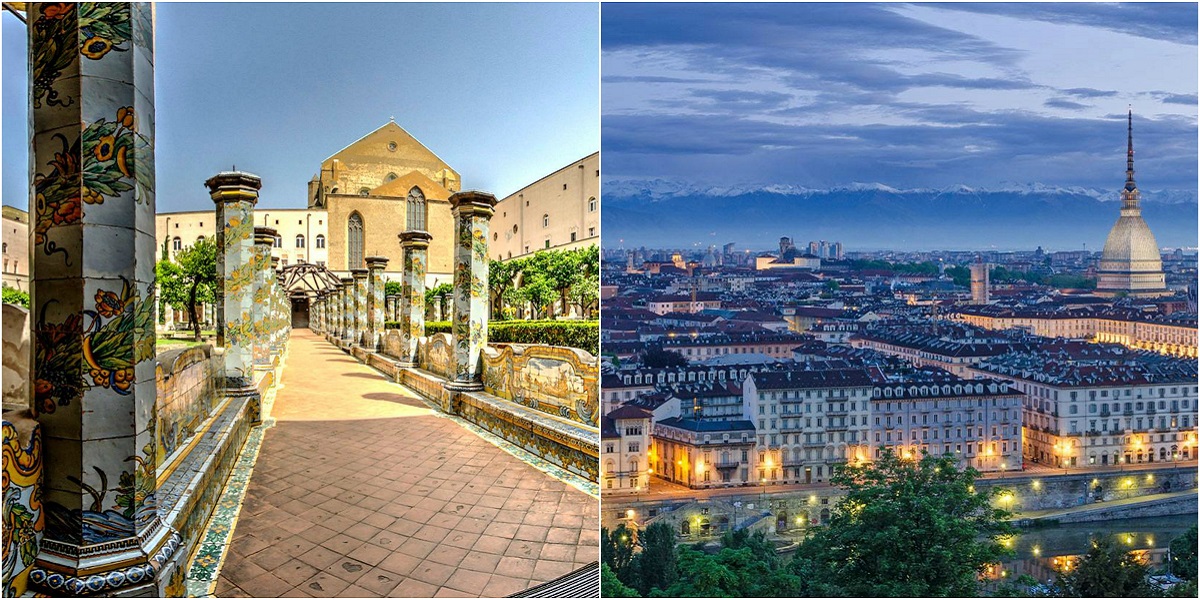
After Florence, Milan and Rome, it's the turn of another great and wonderful Italian city, of which we'll assess ten characteristic aspects, in comparison with as many from our Naples. It's Turin.
by Silvia Semonella
After Florence, Milan and Rome, it's the turn of another great and wonderful Italian city, of which we'll assess ten characteristic aspects, in comparison with as many from our Naples.
It's Turin.
Long a fundamental centre and point of reference for understanding Italian history before and after Unification, it is a city with a two-thousand-year history: it was probably founded as Taurasia, around the 3rd century BC, by the Taurini, a Ligurian people of northern Italy, and turned into a Roman colony by Augustus, under the name Iulia Augusta Taurinorum, in the 1st century BC.
After Ostrogothic rule it became the capital of an important Lombard duchy, later passing, after becoming a Carolingian capital, under the nominal lordship of the House of Savoy in the 11th century. A city of the Duchy of Savoy, in 1563 it became its capital. From 1720 it was also capital of the Kingdom of Sardinia, the state that, in the 19th century, would lead to Italian unification and that made Turin the first capital of the Kingdom of Italy (from 1861 to 1865).
1 - Monastery of Santa Chiara / Church of San Domenico
The first comparison is between two places of worship, located in the centre of the two cities, of medieval origin, whose bare and essential structure they have preserved; both have become symbolic landmarks of their respective historic centres.
The Church of San Domenico is Turin's main medieval archaeological remnant. It underwent many restorations before being returned to its original Gothic features. Construction began in 1227 and was then extended after the second half of the century. Inside, fragments of frescoes from the late 14th century can still be seen.
Its specific distinction is being the only medieval Gothic-style church in the city to have survived to this day and, together with the Church of the Consolata, it can be considered one of the oldest places of worship in the city.
The Church of Santa Chiara, on the other hand, is the largest Gothic basilica in the city of Naples, featuring a monastery that includes four monumental cloisters, the archaeological excavations in the surrounding area and several other rooms housing the Museo dell'Opera (Museum of the Works), which also includes the nuns' choir, with remains of frescoes by Giotto, a large refectory, the sacristy and other rooms.
2 - Stadio San Paolo / Juventus Stadium
Two stadiums for two teams, bitter rivals since forever, who have turned football faith into a religion.
The Allianz Stadium, better known as the Juventus Stadium, is a football ground in Turin, owned by the football club Juventus Football Club, home to its first team's matches since the 2011-2012 season. It is the sixth largest Italian stadium by capacity, with 41507 spectators, and the largest in Piedmont.
It also holds the record of being the first Italian football ground free of architectural barriers, as well as the world's first eco-friendly stadium; it is one of four Italian stadiums (together with the Olimpico in Rome, the Giuseppe Meazza in Milan and the Olimpico Grande Torino) to fall into UEFA Category 4, the highest technical level, and it represents the country's first modern stadium owned by a club.
The quintessentially Neapolitan Stadio San Paolo, on the other hand, originally christened Stadio del Sole (Stadium of the Sun), is located in the Fuorigrotta district, is the city's main multi-sports venue and hosts SSC Napoli's matches.
It is the second-largest stadium in Italy by actual capacity, after the Meazza in Milan, and the third by approved capacity, after the same Meazza and the Olimpico in Rome.
The Stadio San Paolo hosted the match with the highest number of paying spectators in Italy, exactly 89,992, on the occasion of the Napoli-Perugia match of the 1979/80 Italian championship, played on 21 October 1979. However, it was never possible to establish the actual number of spectators present, which was far higher than the official figure; an Italian record still unbeaten. Indeed, on the occasion of Napoli-Juventus in the 1976-77 championship, it was estimated that there were around 95,000 spectators.
3 - Minestra maritata / Bagna càuda
More than typical dishes, they are almost two genuine convivial rituals.
Bagna càuda ("hot dip") is a speciality of Piedmontese cuisine, originating in particular from Astesana, the Langhe, Roero, Monferrato, the southern areas of the metropolitan city of Turin and the provinces of Cuneo, Alessandria and Asti.
It is served in the typical vessel, il diàn or fojòt (in Piedmontese dialect), from which diners all dip together. It is a dish typical of the grape harvest season, therefore eaten mainly in autumn and winter: one legend about its origin has it that it was prepared to reward grape-pickers for their hard work. The recipe is based on garlic, extra virgin olive oil and desalted anchovies, all reduced to a sauce through patient slow cooking. It is eaten by dipping various kinds of seasonal vegetables, usually divided between raw and cooked (especially cardoons, oven-baked onions, raw or roasted peppers, raw cabbage leaves, cauliflower, Jerusalem artichokes, beetroot, steamed potatoes, radishes, turnips and many others). It can be paired with a full-bodied red wine.
Minestra maritata ("married soup"), on the other hand, is a dish typical of Campanian cuisine, prepared especially at Christmas time. The term "maritata" comes from the fact that the meat and vegetable ingredients "marry" one another, joining together in the soup. Over the years the recipe has been much reworked, with ingredients removed or changed as they become increasingly rare to find commercially. During traditional festivities, however, at Naples' neighbourhood markets, you can still buy the typical vegetables required for the preparation, which are chicory, small escarole (scarulelle), savoy cabbage and borage (which lends a slightly bitter note). In some variants, chicory catalogna (in Neapolitan: puntarelle) is also used. The typically used meat, on the other hand, is lower-grade pork, such as pork ribs, sausages (typically the so-called 'nnoglia, or salame pezzente, "poor man's salami") and other cuts.
Finally, following the oldest tradition, instead of toasted bread one can use scagliuozzi, typical rounded fried cornmeal fritters, which are laid at the bottom of the bowl.
4 - MANN / Museo Egizio
Both are museum complexes of enormous artistic value, a jewel in Italy's crown, lending prestige on both a national and global level.
«La strada per Menfi e Tebe passa da Torino» ("The road to Memphis and Thebes passes through Turin") (Jean-François Champollion).
The Museo Egizio di Torino (Egyptian Museum of Turin) is the oldest in the world entirely dedicated to Nile civilisation, and is considered, for the value and quantity of its artefacts, the most important in the world after that of Cairo.
In 2016 the museum recorded 852,095 visitors, making it the tenth most visited Italian state museum site. Let's briefly retrace its history.
In 1759 a keen Egyptologist from Padua, Vitaliano Donati, travelled to Egypt to carry out excavations and found various artefacts, which were sent to Turin. In the early 1800s, following Napoleon's campaigns in Egypt, a genuine craze for collecting Egyptian antiquities broke out in Europe. Bernardino Drovetti, from Piedmont, French consul general during the occupation of Egypt, collected during this period over 8000 pieces, including statues, sarcophagi, mummies, papyri, amulets and various jewellery. In 1824 King Carlo Felice purchased this great collection and, adding to it other classical antiquities from the Savoy family, gave life to the world's first Egyptian Museum.
The museum is dedicated exclusively to Egyptian art. You can find mummies, papyri and everything related to ancient Egypt (including embalmed animals). In 2013 the museum was included by the British newspaper The Times in its list of the 50 best museums in the world.
The Museo Archeologico Nazionale di Napoli (MANN), on the other hand, is among the most important in the city. It boasts the richest and most valuable collection of artworks and artefacts of archaeological interest in Italy and is considered one of the most important archaeological museums in the world, if not the most important as regards the history of the Roman era. The building that currently houses the museum also has notable architectural significance: it is, in fact, one of the most imposing monumental palaces in Naples. It stands, among other things, on the site of an ancient necropolis of Greek Neapolis: that of Santa Teresa.
According to history, Ferdinando IV, once he came to the throne and after expelling the Jesuits from the Kingdom of Naples in 1767, permanently moved, in 1777, the university of the Regi Studi (Royal Studies) into their former convent of the Salvatore, and decided to transfer to the palace both the "Museo Hercolanese" (Herculaneum Museum), from the Palace of Portici, and the "Museo Farnesiano" (Farnese Museum), from the Palace of Capodimonte, also including the library and the Schools of Fine Arts.
The Neapolitan MANN museum, in turn, is made up of three main sections: the Farnese collection (consisting of artefacts from Rome and its surroundings), the Pompeian collections (with artefacts from the Vesuvian area, mostly part of the Bourbon collections) and the Egyptian collection, which, in importance, ranks third in the world after those of the Egyptian museum of Cairo and the Museo Egizio of Turin, precisely.
Since 2005, in the underlying "Museo" metro station, the Neapolis station has been opened, where a series of small rooms display archaeological finds unearthed during the metro excavations and now part of the museum's collection.
5 - Porta Medina / Porta Palatina
The Porta Palatina was the gate that allowed access from the north to Augusta Taurinorum, the Roman civitas known today as Turin. It represents the main archaeological evidence of the city's Roman era, as well as one of the best-preserved 1st-century BC city gates in the world.
Together with the ancient theatre, a short distance away, it is included in the area of the Archaeological Park inaugurated in 2006.
Our own Porta Medina, on the other hand, was an ancient gate of the city of Naples, which stood at the start of Piazza Montesanto, at the end of Via Portamedina.
In 1597, during the viceroyalty of the Count of Olivares, Enrique de Guzmán, an opening was illegally made (in Neapolitan dialect pertuso, meaning "hole") in the city walls, in order to ease the passage of those coming from the hilly area who, to enter the city, otherwise had to travel all the way to the Porta dello Spirito Santo. In 1640, during the reign of Philip IV, Cosimo Fanzago, commissioned by the viceroy Duke of Medina, built the actual gate, formalising the pertuso that had been opened. For this very reason, the structure, which was dedicated to the viceroy, continued to be called by the people Porta Pertuso (the "Hole Gate").
6 - Santa Rosa / Gianduiotto
The gianduiotto is a typical chocolate of Piedmont, produced above all in Turin. It is made by blending cocoa and sugar with the famous Tonda Gentile del Piemonte hazelnut, renowned for its quality; the hazelnuts, roasted and ground, turn into a paste, as they contain oil. It was first produced by the Turin confectionery company Caffarel and presented to the public at the 1865 carnival by the Turinese carnival character Gianduja, from whom it takes its name, who handed it out in the streets.
The Santa Rosa, on the other hand, is one of the typical pastries of Neapolitan tradition, shell-shaped, with a soft filling, topped with pastry cream and candied sour cherries.
It originated in the 1600s, in the Monastery of Santa Rosa da Lima in Conca dei Marini, on the Amalfi Coast. The story has it that, with semolina cooked in milk, left over from lunch, the nun who cooked decided to prepare a dough, adding lemon liqueur, dried fruit and sugar. A separate mixture was then enriched with bread, white wine and lard, worked for a long time and shaped like a pouch resembling a nun's hood, into which the first dough was inserted. Once sealed, it was baked in a wood-fired oven and, once it took on its classic golden colour, the new pastry was finished with a ring of pastry cream and candied sour cherries. This delicacy took the name Santa Rosa from the monastery where it was first prepared.
For almost a century and a half, however, the recipe for the Santa Rosa sfogliatella remained kept within the walls of the Conca dei Marini monastery. It was only in the early 19th century that a Neapolitan pastry chef, Pasquale Pintauro, managed to obtain (perhaps precisely from a nun aunt) the original recipe, which he modified by removing the sour cherries and the pastry cream, thereby creating the riccia variant ("curly") of the sfogliatella napoletana.
7 - Palazzo Reale di Napoli / Palazzo Reale di Torino
The Palazzo Reale di Torino (Royal Palace of Turin), the first of the Savoy residences in Piedmont, is located in the heart of the city, next to the famous Piazza Castello. The heart of the Savoy court and the centre of the dynasty's power, it has been declared a UNESCO World Heritage Site.
The Palazzo Reale di Napoli (Royal Palace of Naples), on the other hand, is located in Piazza Plebiscito, in the city's historic centre. It was the historic residence of the Spanish viceroys for over one hundred and fifty years, of the Bourbon dynasty from 1734 to 1861, interrupted only for a decade, in the early 19th century, by French rule under Joseph Bonaparte and Joachim Murat and, following Italian Unification, of the Savoy family: ceded in 1919 by Victor Emmanuel III of Savoy to the State, it is now used mainly as a museum complex, particularly the Royal Apartments, and houses the national library.
8 - Parco di Capodimonte / Parco del Valentino
«...ricordi quelle sere passate al Valentino, col biondo studentino, che ti stringeva sul cuor...» ("...do you remember those evenings spent at the Valentino, with the fair-haired young student, who held you close to his heart...") (Piemontesina bella, a popular Turinese song).
Situated along the banks of the Po, the parco del Valentino is Turin's largest and most famous public park.
The origin of the name seems to go back to the earliest Roman settlements: it seems there was a very ancient chapel dedicated to San Valentino (Saint Valentine), holding part of the saint's relics which had arrived directly from Terni. It is not known whether the chapel later fell into ruin or was destroyed, but the relics were taken to the nearby little church of San Vito, on the hill, across the river. The Valentino area, meanwhile, was first inhabited by the noble Birago family, who built a villa there; then, Emanuele Filiberto of Savoy bought the whole area towards the middle of the 16th century.
Between 1630 and 1660 the castle of the same name was built, an imposing building by Carlo and Amedeo di Castellamonte, used as a summer residence of the Savoy family. The area went from a simple riverside park to a structure with elegant, refined gardens. It was only in the 19th century that the real work of transformation into today's city park began, following the romantic design of the French landscape architect Barrillet-Deschamps.
The Real Parco di Capodimonte is the park par excellence of the city of Naples, located in the area from which it takes its name. Construction, together with the respective Royal Palace, began in 1742 and was completed the following year, under the guidance of the architect Ferdinando Sanfelice, who designed a visually striking structure in an Enlightenment style. All the buildings present in the park, used as dwellings, churches, factories and farms, were also restored. Later, upon the return of Ferdinando I to the throne of the Kingdom of the Two Sicilies, after the brief interlude of the French decade, the park was opened twice a year to all citizens, to coincide with religious holidays, to allow access to the Capuchin hermitage, located on the edge of the woods. Badly damaged during the Second World War, between 1966 and 1967 it was then restored for the inauguration of the Museo Nazionale di Capodimonte and opened as a public park.
9 - Biblioteca Nazionale di Napoli / Biblioteca Nazionale di Torino
The origins of the Biblioteca nazionale torinese go back to 1720, when Vittorio Amedeo II di Savoia established the Regia Biblioteca Universitaria, the result of merging the Turin university's book collection with the ducal Savoy holdings. Between the 18th and 19th centuries, many bequests and acquisitions flowed into the library, including the extremely precious, nearly complete collection of Antonio Vivaldi's autograph scores, made up of around 450 documents belonging to the musician.
The Reale Biblioteca Borbonica, now the Biblioteca Vittorio Emanuele III of Naples, is housed at the Palazzo Reale, as mentioned, and has a collection of 1,480,747 printed volumes, 319,187 pamphlets and 18,415 manuscripts, making it the third largest among Italian libraries, after the two Central National Libraries of Rome and Florence.
The Library was established at the end of the 18th century, bringing together in the Palazzo degli Studi, today home to the Museo Archeologico, the collections from the Farnesiana and Palatina libraries, kept until then at the Reggia di Capodimonte. Collections from the Jesuit library were later added, the Jesuits having been expelled, as mentioned, from the Kingdom of Naples in 1767, as well as the library of the Reale Accademia, followed by the volumes of the Cartesian library of the Prince of Tarsia. To increase the book collection, it was established that the printers of the Kingdom had to deliver a copy to the library of every publication put on sale. In the early 19th century, the book collections of the suppressed monasteries of the Certosa di San Martino, the Benedictine monastery of Santi Severino e Sossio and San Giovanni a Carbonara were incorporated.
10 - Università Federico II / Politecnico di Torino
The Regio Politecnico di Torino was founded in 1906, and its first home was the Valentino castle. At the start of the 20th century, it covered various academic fields, engaging with both the European scientific world and the industry of the Turin area and Italy as a whole. The institute of aeronautics and various new laboratories were established. It specialises in engineering and architecture courses, with 22 first-level degree courses (3 in Architecture, 19 in Engineering) and 29 second-level degree courses (6 in Architecture, 23 in Engineering).
The Università Federico II, on the other hand, is the main Neapolitan academic institution and one of the most important in Italy and Europe. Among the oldest universities in Europe, founded on 5 June 1224, it is also famous for being among the first to be established by a state decree.
The founding of the Studium was decreed by Emperor Frederick II of Swabia via a circular letter sent from Syracuse. There were two main reasons that led the emperor to establish it: firstly, the exclusive training of the administrative and bureaucratic staff of the Kingdom's ruling class, and thus the preparation of jurists who would help the sovereign in defining the state's legal system and enforcing the laws; secondly, to make it easier for his subjects to receive a cultural education, sparing them unnecessary and costly travels abroad. The choice of location fell on Naples for cultural reasons (the city had a long tradition in this regard, linked to the figure of Virgil), but also for geographical and economic ones (sea trade, the mild climate and the strategic position within the Kingdom). For the organisation of the Studium, the work of two excellent Campanian jurists was employed: Pier delle Vigne and Taddeo da Sessa.
Posted in:
Places in Naples
Related posts
-
 The Roman Theatre of Neapolis
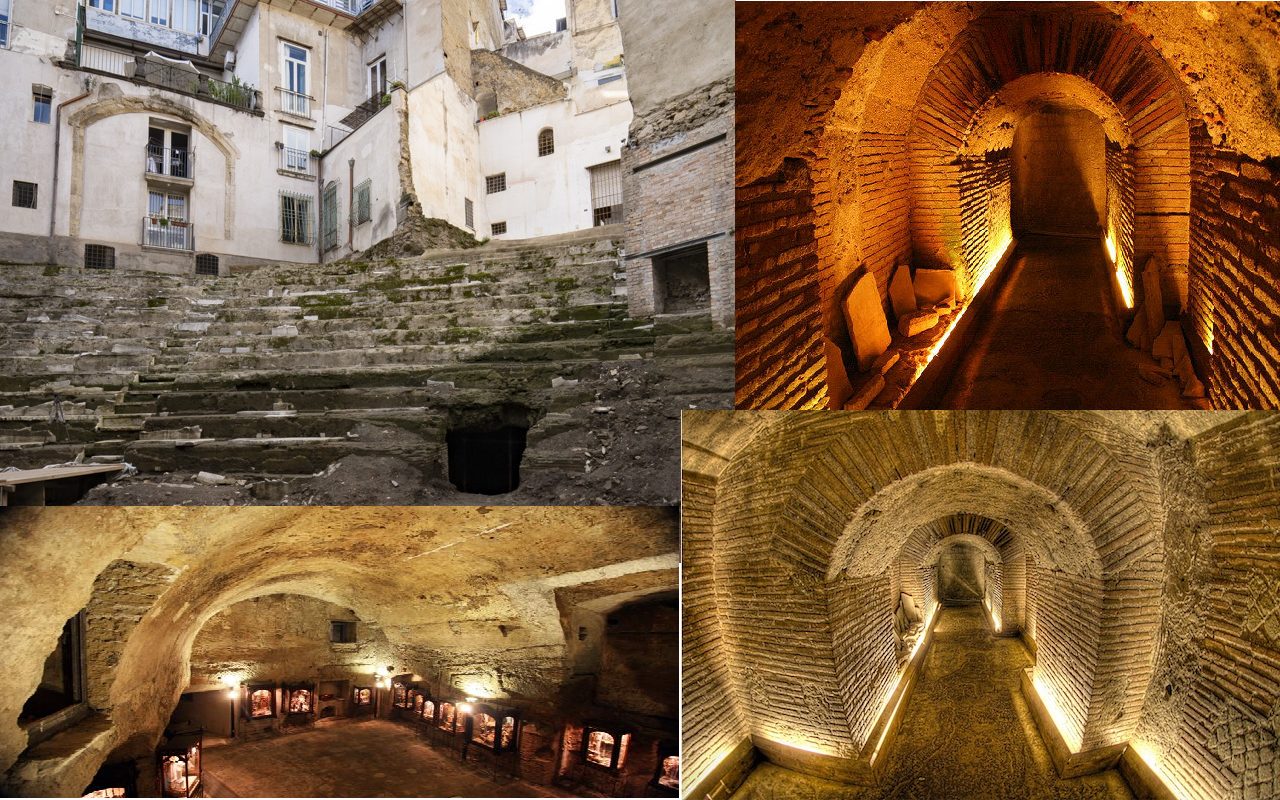
Among the many wonders of Naples' historic centre stands the ancient Roman Theatre of Neapolis, between what are now...Read more
-
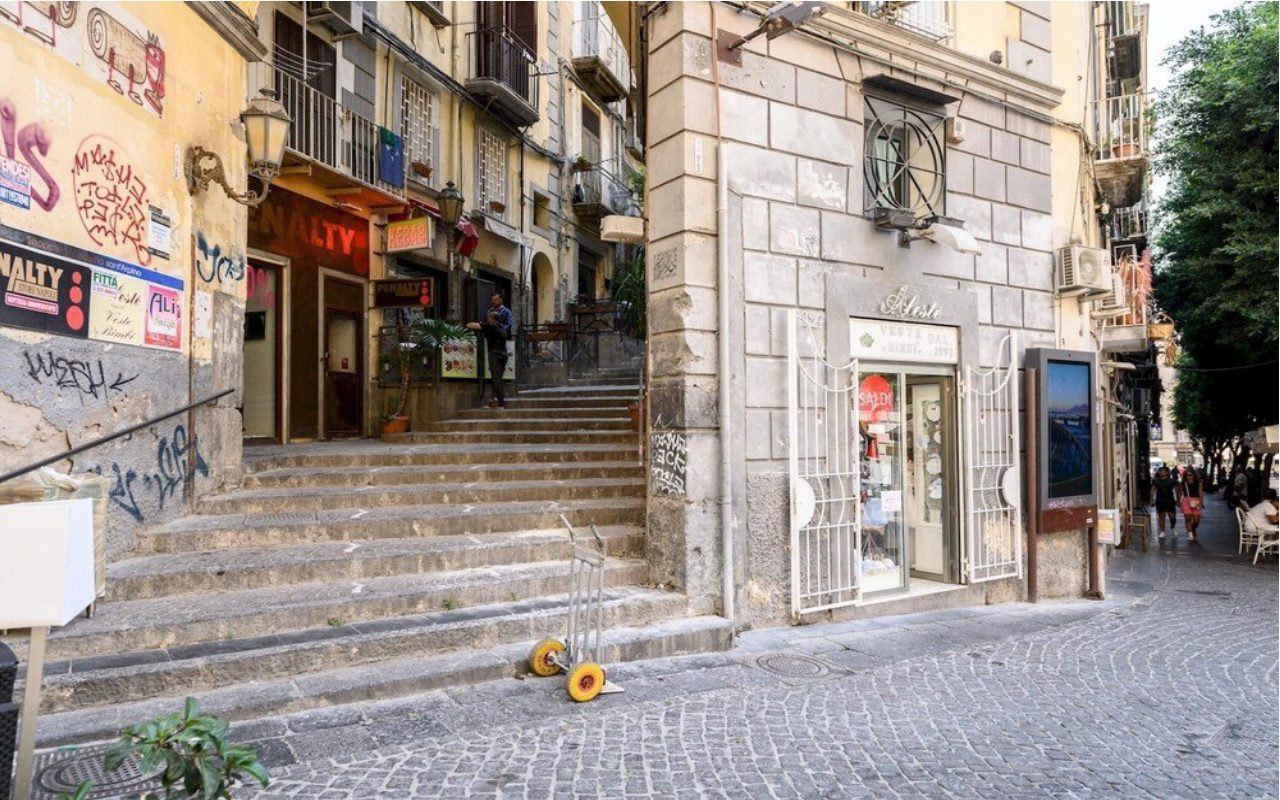 Discover Vicoletto Sant'Arpino: History and Beauty of Naples
There are corners of Naples that tell incredible stories, that take your breath away and make it unique, sincere and...Read more
-
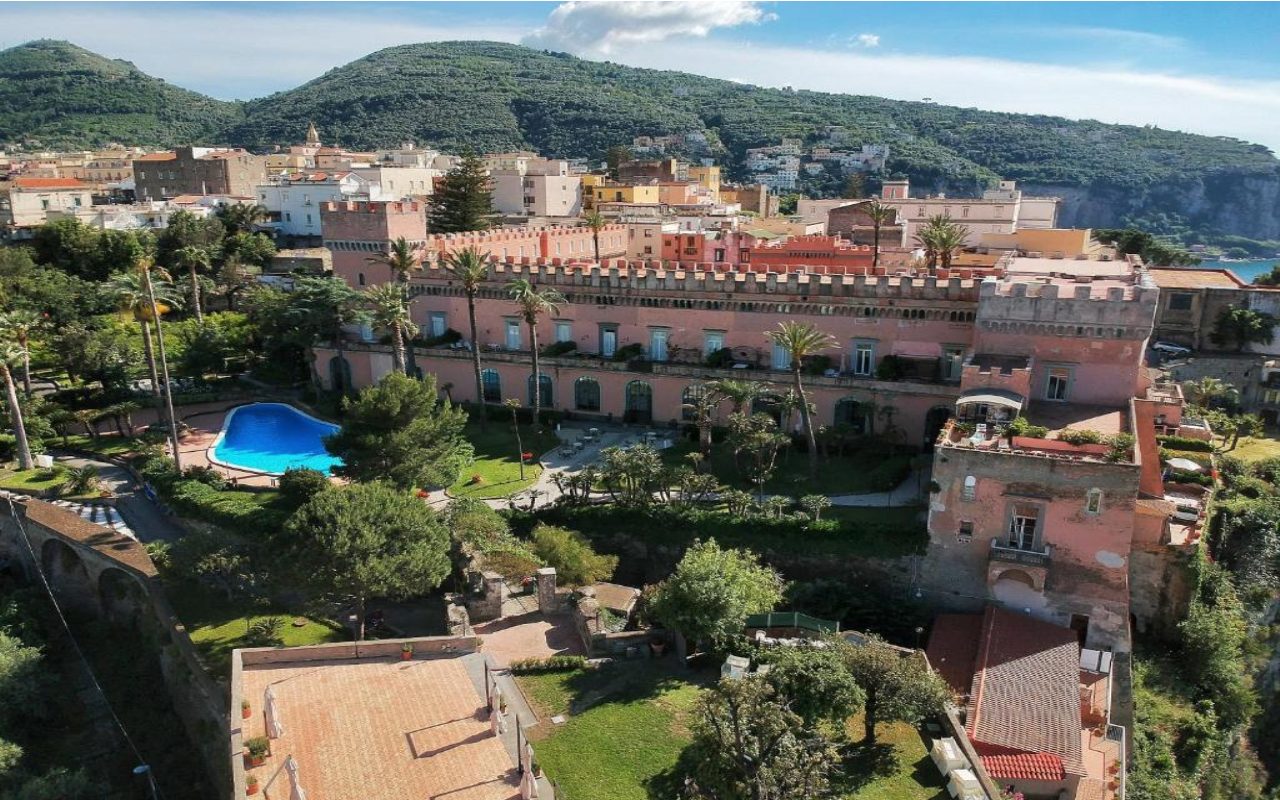 Giusso Castle: the legends of Vico Equense
Built at the end of the 13th century, Giusso Castle was designed as both a military fortress and a residence.Read more
-
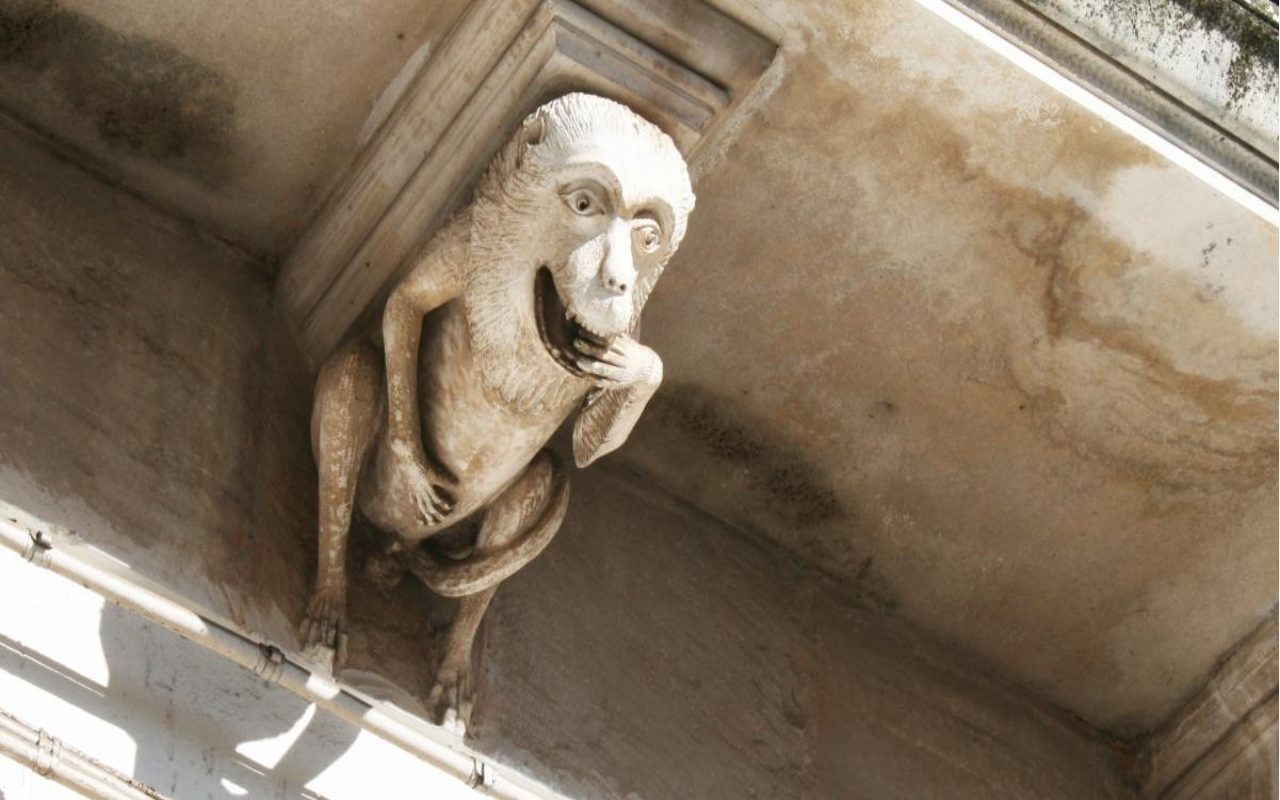 The apotropaic stone masks of lava rock and marble
Neapolitan apotropaic masks are truly fascinating works of art that can be admired on numerous historic buildings...Read more
-
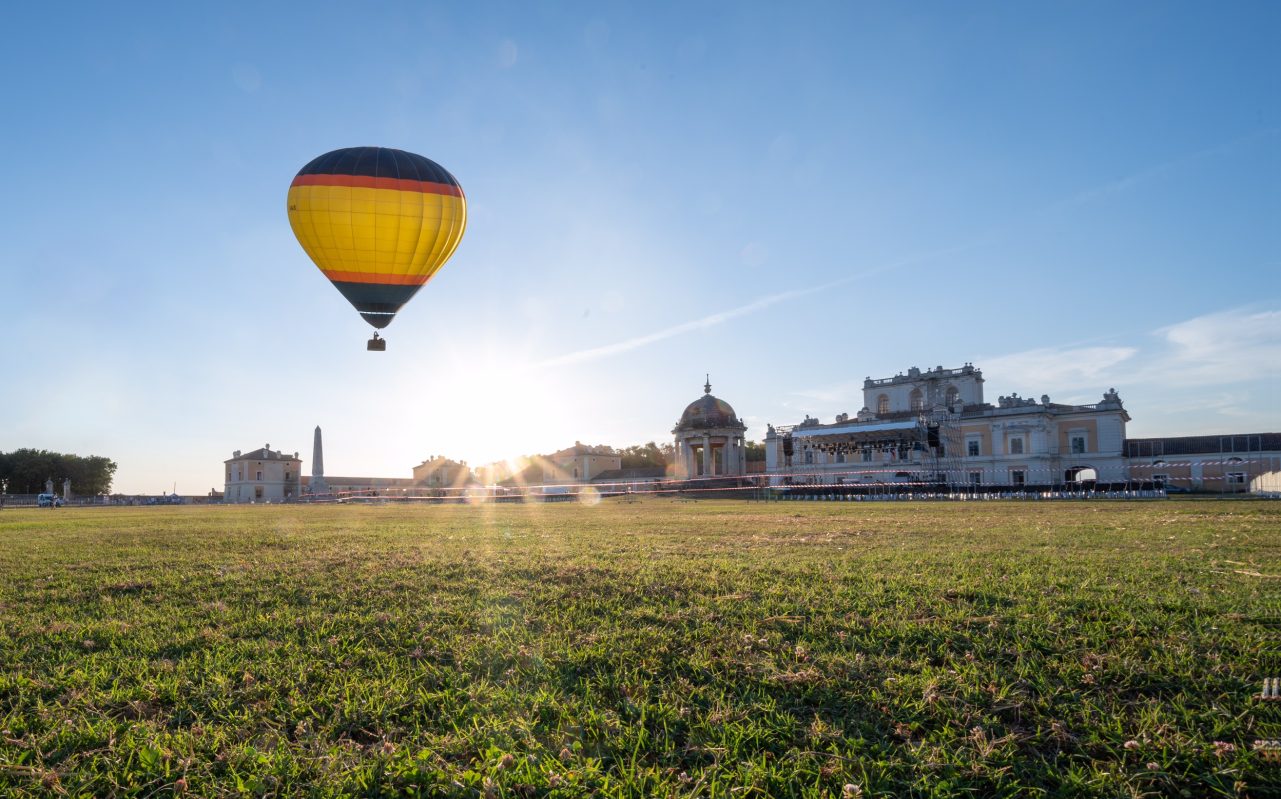 THE ROYAL PALACE OF CARDITELLO
The Tenuta Storica di Carditello (Historic Estate of Carditello), also known as the Reggia di Carditello (Royal...Read more
Leave a comment