



In Naples, a graduation is never a private affair: it's a neighbourhood celebration. Here's how to choose an original...
Latest posts
-
 Original Neapolitan graduation gift: ideas for the graduate (him and her)Read more
-
 Asso 'e mazze: meaning and history of the Neapolitan ace of clubsRead more
The strongest card on the green table becomes, in Naples, the most elegant way to say who really calls the shots....
-
 Michelina Di Cesare, the brigantessa who defied a kingdomRead more
Born poor in Terra di Lavoro, Michelina Di Cesare chose the maquis and the rifle against a newly united Italy. A...
-
 Neapolitan Hoodies: The Autumn 2026 Style GuideRead more
When the air turns crisp, in Naples people don't just reach for a hoodie: they reach for a piece of identity. Here's...
-
 Maradona Stadium: City Council allocates €50 million for Euro 2032Read more
The City Council has allocated €50 million for the redevelopment of the Diego Armando Maradona stadium, ahead of...
-
 Pizza Maxima 2026: Franco Pepe Is Once Again Best Pizzeria in ItalyRead more
At the fifth edition of Pizza Maxima, the Oscars of Italian pizza, Franco Pepe confirms his title as Best Pizzeria in...
-
 ‘L’acqua è poca e ‘a papera nun galleggia’: what it meansRead more
When the means are few, so is the result. Let's discover the most realistic Neapolitan saying there is.
-
 Avanti Scugnizzi: the story of the year's most loved T-shirtRead more
One word, ‘scugnizzo’ (Neapolitan street kid), and it holds the whole of Naples inside it. We tell you how the year's...
-
 'Chi chiagne fotte a chi ride': what it means and why it's truer than everRead more
At the market, at the counter, in the family: there's always someone who complains and gets more. It's the sharp...
-
 San Gennà, futtatenne! (Saint Januarius, don't worry about it!) San Gennaro, 19 September and the patron saint's t-shirtRead more
Who San Gennaro was, the miracle of the blood that liquefies, and the feast on 19 September. Plus that close,...
Blog categories
Search in blog
Archived posts
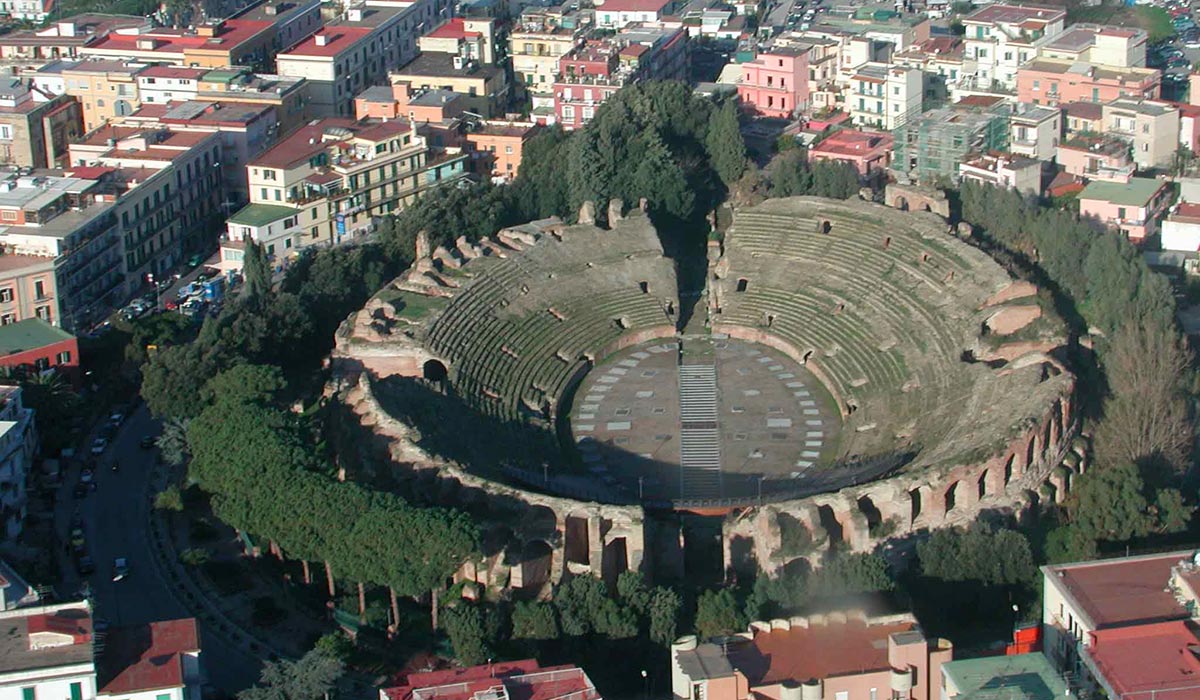
The Flavian Amphitheatre, Pozzuoli's Colosseum
We saw it with the ancient Thermal Complex located in Fuorigrotta, on Via Terracina, and we realise it again in Pozzuoli, where the marvellous Flavian Amphitheatre stands, second in capacity only to the Colosseum and the Campanian Amphitheatre of Capua, thanks to a cavea that could hold up to 40,000 spectators.
by Simona Vitagliano
Campania, like many other regions of southern Italy, is one of those territories where you only need to go for a walk, even through its most chaotic streets, to "stumble" upon archaeological remains.
History
The Flavian Amphitheatre is one of the many archaeological sites immersed in the full flow of city life: those places you pass by every day on your way to work or back home, so used to living side by side with realities thousands of years old; the people of Naples and Pozzuoli, in fact, are so accustomed to these scenes that they barely notice them any more. In other parts of the world, a single stone can be enough to open a museum: in Campania that is not always the case, perhaps because the entire region is itself one immense archaeological site, bearing witness to the ancient history of our past.
This wonderful Roman amphitheatre is part of the Archaeological Park of the Campi Flegrei (Phlegraean Fields), dates back to the second half of the 1st century AD, and was built where the main roads of the region met, the Via Domitiana and the road to Naples, replacing the older venue for shows, dating from the Republican age, which had become too small due to the enormous population growth Puteoli experienced during that period.
It seems that the three most important Roman amphitheatres in the world are, in some way, connected: just as it is widely accepted that the Campanian Amphitheatre (the first of the Roman world) served as a model for the Colosseum, it also appears that the architects of the latter were the same ones behind the Flavian Amphitheatre, which was, in fact, built shortly after it.
As for the exact timing, however, doubts remain: according to some texts, its construction would have taken place under Vespasian, with an inauguration carried out by Titus; according to a group of scholars, however, the presence of opus reticulatum suggests a foundation under Nero, whose role would then plausibly have been erased through a process of damnatio memoriae. It should be said, though, that the reticulated brickwork is not the only building technique found at the site, since the use of fired bricks can also be seen; finally, one cannot fail to mention an epigraphic inscription which reads: "Colonia Flavia Augusta/Puteolana pecunia sua" ("The Colonia Flavia Augusta built it at its own expense") and the fact that the type of amphitheatre closely resembles that of the Colosseum, so the hypothesis of a date in the Flavian age (shortly after Nero's death, that is) would also be plausible.
The site was rediscovered in 1839, along with the works needed to bring it to light: by the end of that same century the excavation work was completed, but only in 1947, with further archaeological activity, did the monument become fully accessible, also cleared of the debris that had built up in the meantime.
Structure
-

- Ph: Simona Vitagliano
-

- Ph: Simona Vitagliano
-

- Ph: Simona Vitagliano
-

- Ph: Simona Vitagliano
-

- Ph: Simona Vitagliano
-

- Ph: Simona Vitagliano
-

- Ph: Simona Vitagliano
-

- Ph: Simona Vitagliano
-

- Ph: Simona Vitagliano
-

- Ph: Simona Vitagliano
-

- Ph: Simona Vitagliano
-

- Ph: Simona Vitagliano
-

- Ph: Simona Vitagliano
-

- Ph: Simona Vitagliano
-

- Ph: Simona Vitagliano
-

- Ph: Simona Vitagliano
-

- Ph: Simona Vitagliano
-

- Ph: Simona Vitagliano
-

- Ph: Simona Vitagliano
-

- Ph: Simona Vitagliano
-

- Ph: Simona Vitagliano
-

- Ph: Simona Vitagliano
-

- Ph: Simona Vitagliano
-

- Ph: Simona Vitagliano
-

- Ph: Simona Vitagliano
The Flavian Amphitheatre is arranged over three superimposed orders of arches (ima, media and summa cavea, the tiers of seating) supported by pillars and "crowned" at the top by an attic storey, following the architectural conventions of the time, all within a visually elliptical plan.
The walking surface of an elliptical portico originally surrounded the complex and was made of large travertine slabs, raised one step above street level. From this same portico, bordered by stone pillars decorated with half-columns, one entered the building through the entrances, and twenty flights of stairs also began here, allowing access to the highest section of the tiered seating.
An orderly and controlled flow of spectators took place through internal ring-shaped corridors, which guided the public to the cavea through the vomitoria (access openings set along the tiers of seating).
In the underground levels too, set at a depth of around 7 metres, further similar corridors could be found, along with mechanisms (of which only a few parts survive today) used to raise the cages carrying wild beasts into the arena and, very probably, also stage elements that enlivened the shows. Within the perimeter of the arena, in fact, there were several trapdoors which, during performances, were closed off with wooden planks.
The connection with San Gennaro
The Flavian Amphitheatre is also linked to the events surrounding the death of San Gennaro (Saint Januarius).
During the persecutions of Diocletian, in fact, the first sentence handed down for the martyr (before, that is, the beheading that later took place in the Solfatara area) was that he should be torn apart by wild beasts right here: so Gennaro, Festo, Desiderio and Sossio (who shared the same sentence ad bestias) came to be held in one of the site's cells, which then, in 1689, by order of the then Bishop of Pozzuoli, Domenico Maria Marchese, became a chapel dedicated to the cult of their martyrdom (albeit without any certain historical foundation), decorated with a majolica-tiled altar and a ceramic statue depicting an embrace between Gennaro and Procolo, as also recorded on two plaques placed at the entrance; sadly, today this space, despite having been a destination for pilgrimages up until thirty years ago — so much so that, in 1715, an adjoining space had to be added to accommodate the faithful (decorated with a canvas depicting the beheading of San Gennaro and his companions, and with a stone altar) — is now completely abandoned, at risk of collapse and inaccessible due to structural safety concerns. Last year the Coordination of the Phlegraean-Giuglianese Associations (Co.As.) issued an appeal to the authorities so that "the funds allocated for the enhancement of our priceless historical, artistic and cultural heritage might finally be used, which could bring about conditions for development and employment".
Info
- Ticket: €4.00 (which covers the Archaeological Park, the Campi Flegrei Museum at Baia and the Archaeological Park of Cuma, valid for 2 days!);
- Days and opening hours: Monday to Sunday, closed weekly on Tuesday, between 9 a.m. and one hour before sunset;
- Address: via Serapide, Pozzuoli.
Posted in:
Places in Naples
Related posts
-
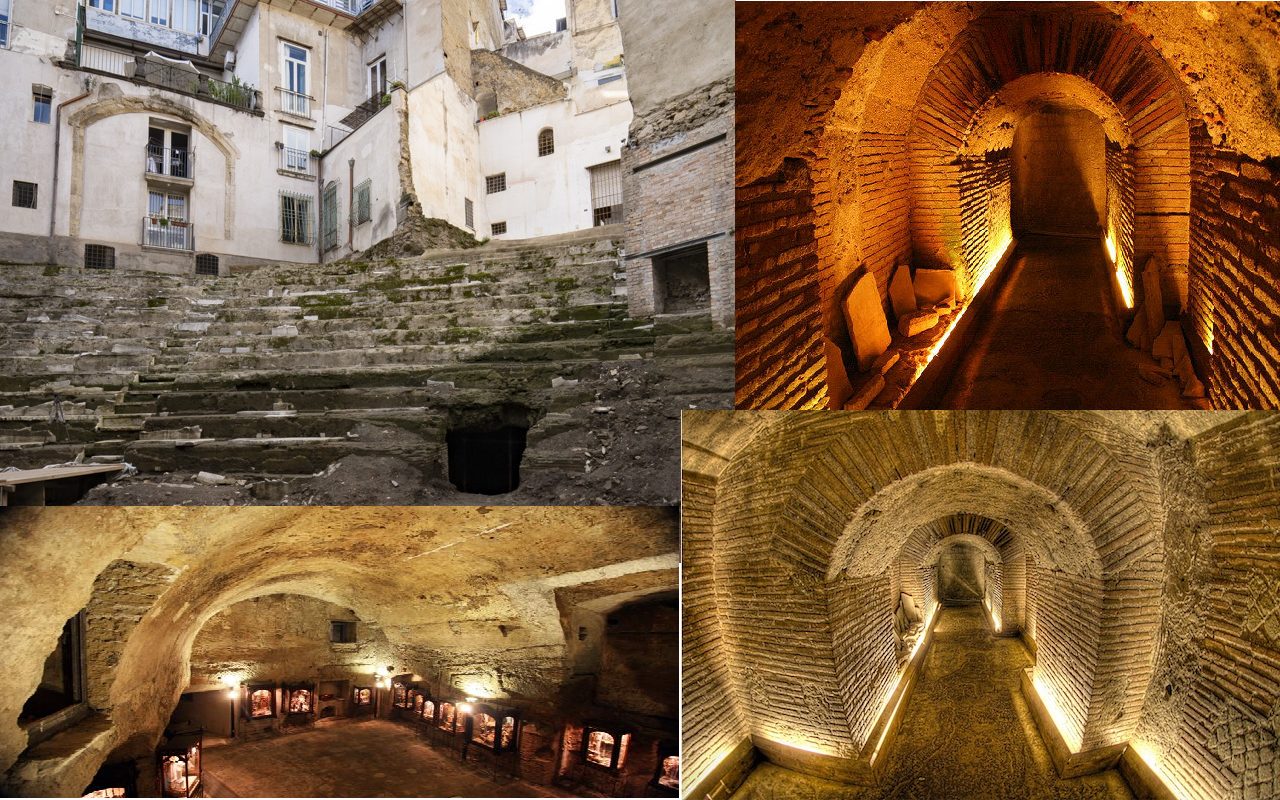 The Roman Theatre of Neapolis
Among the many wonders of Naples' historic centre stands the ancient Roman Theatre of Neapolis, between what are now...Read more
-
 Discover Vicoletto Sant'Arpino: History and Beauty of Naples
There are corners of Naples that tell incredible stories, that take your breath away and make it unique, sincere and...Read more
-
 Giusso Castle: the legends of Vico Equense
Built at the end of the 13th century, Giusso Castle was designed as both a military fortress and a residence.Read more
-
 The apotropaic stone masks of lava rock and marble
Neapolitan apotropaic masks are truly fascinating works of art that can be admired on numerous historic buildings...Read more
-
 THE ROYAL PALACE OF CARDITELLO
The Tenuta Storica di Carditello (Historic Estate of Carditello), also known as the Reggia di Carditello (Royal...Read more
Leave a comment