
There's a word that explains everything in Naples, and it can't be translated into any language. It's called...

Free shipping in Italy
On the entire catalogue. Delivery within 3 working days, with international shipping available at checkout.

5,000+ Customers

4,6/5 su Facebook
La valutazione vera della nostra pagina, 147.000 follower. Leggi le recensioni.

Pay in 3 or more instalments
Latest posts
-
 Cazzimma: meaning, origin and why it's untranslatableRead more
 -
 Who is Minollo? Totoro speaks NeapolitanRead more
He's not an animal, and he wasn't born in Naples. But like everyone who passes through here, he stayed.
-
 Oilloc', oiccann', oillann': what they mean and how to use themRead more
Three words for «there it is» at three different distances. Neapolitan has a grammar that Italian doesn't.
-
Neapolitan t-shirts with dialect phrases: the best ones (and what they really mean)Read more
Every Neapolitan phrase is a little portable theatre: a punchline, a philosophy, sometimes an affectionate threat....
-
 McFratm, the T-shirt dedicated to Scott McTominayRead more
The new T-shirt from Napoli Tattà dedicated to Scott McTominay, Napoli's midfielder wearing the number 8 shirt
-
 "Sono napoletano, orgoglioso del mio vulcano", the new chant of Napoli's fansRead more
"Sono napoletano, orgoglioso del mio vulcano" (I'm from Naples, proud of my volcano), the new chant of Napoli's fans...
-
 Iglesia Maradoniana (The Church of Maradona)Read more
Iglesia Maradoniana (The Church of Maradona), a parody religion founded by supporters of the former Argentine...
-
 Rose Villain wears the ironic t-shirt with the word “pret” at SanremoRead more
Rose Villain had a hilarious moment at the Sanremo Festival 2025: just before stepping on stage for her evening...
-
 Tu si 'na cosa grandeRead more
"Tu si 'na cosa grande" (‘You are something great’ in Neapolitan dialect) is one of the most famous and best-known...
-
 The verb "dovere" (to have to) in NeapolitanRead more
I must, you must… it's undoubtedly one of the trickiest things to write correctly in the Neapolitan language.
Blog categories
Search in blog
Neapolitan Day: the fountains of Naples
by Silvia Semonella
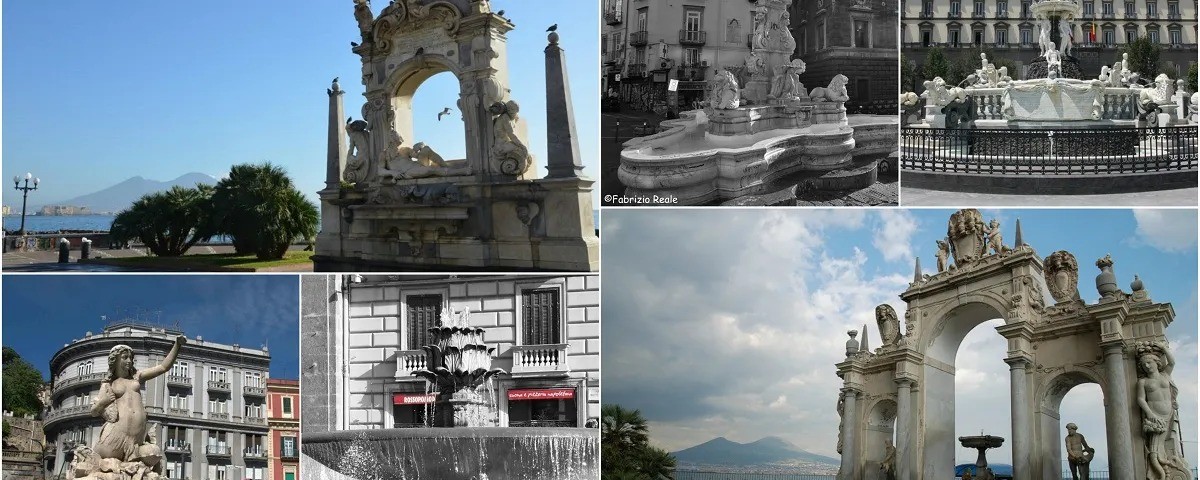
“E tutte le fontane di Napoli sono lagrime: quella di Monteoliveto è formata dalle lagrime di una pia monachella che pianse senza fine sulla Passione di Gesù; quella dei Serpi sono le lagrime di Belloccia, una serva fedele innamorata del suo signore; quella degli Specchi è fatta delle lagrime di Corbussone, cuoco di palazzo e folle di amore per la regina cui cucinava gli intingoli; quella del Leone è il pianto di un principe napoletano, cui unico e buon amico era rimasto un leone che gli morì miseramente; e quella di fontana Medina sono le lagrime di Nettuno, innamorato di una bella statua cui non arrivò a dar vita” (And all the fountains of Naples are tears: the one at Monteoliveto is made of the tears of a devout little nun who wept endlessly over the Passion of Christ; the one at Serpi is made of the tears of Belloccia, a faithful servant in love with her master; the one at Specchi is made of the tears of Corbussone, the palace cook, madly in love with the queen for whom he cooked his sauces; the one at Leone is the weeping of a Neapolitan prince whose only good friend, a lion, had died a wretched death; and the one at Fontana Medina is made of the tears of Neptune, in love with a beautiful statue he never managed to bring to life).
This is how Matilde Serao, in “Leggende napoletane” (“Neapolitan Legends”), describes the most famous fountains of Naples, an integral part of the city's urban landscape.
In Neapolitan history, fountains have played a hugely important, twofold role: first of all, they served for water supply and for the distribution of water, whether from springs or aqueducts, to the population, and secondly, as a celebration of the power and generosity of the sovereigns who, over the years, succeeded one another on the throne of Naples.
Many no longer exist, or have been altered or moved, but some truly monumental ones of rare beauty remain.
The Neptune Fountain
Source: Il Portale del Sud
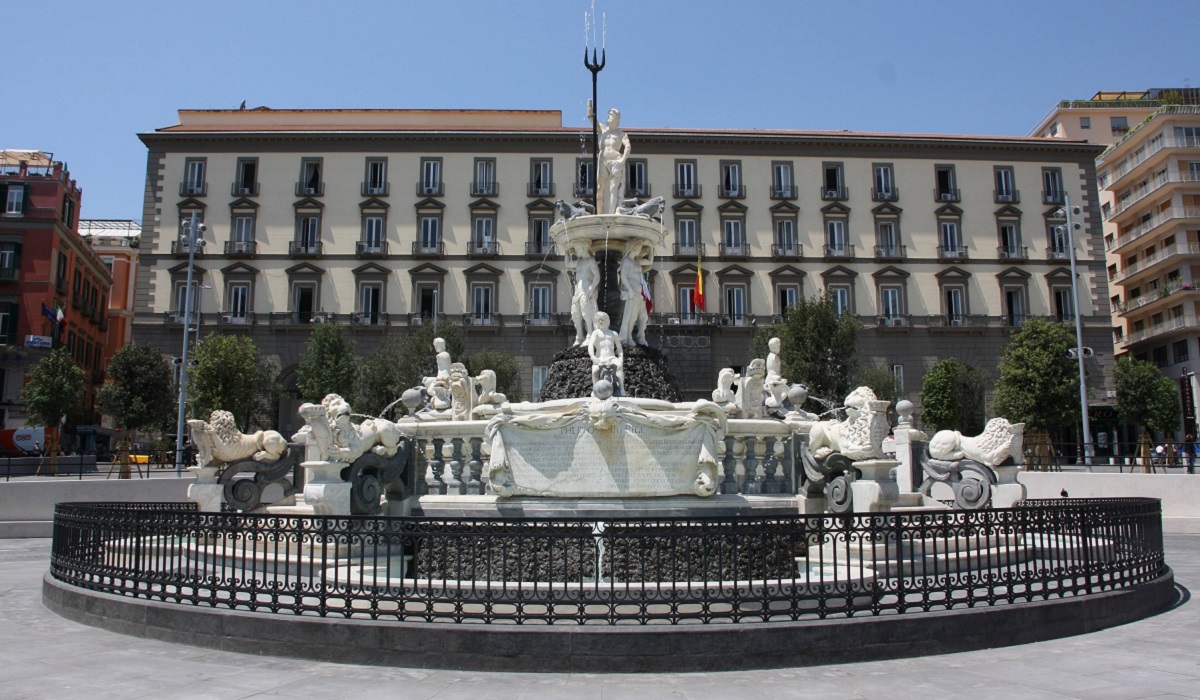
The Neptune Fountain, located in Piazza Municipio, was commissioned by the viceroy Enrico di Guzmán, Count of Olivares, who ordered its construction towards the end of the 16th century, carried out by Michelangelo Naccherino, Angelo Landi, Pietro Bernini and Domenico Fontana. It was built near the arsenal but, over the centuries, has undergone several moves and various changes. The original structure featured a large basin supported by four dolphins, from which rose as many caryatids. Around 1625, since the area where it had been placed had no water, the viceroy Don Antonio Alvarez de Toledo, Duke of Alba had it moved to Largo di Palazzo (today's Piazza Plebiscito). From there, as it got in the way of square festivities, it was relocated to S. Lucia and, once again, in 1638, to via Medina; it was during this period that it also underwent works of enlargement and enrichment. After the damage it suffered during the Masaniello revolt, it was restored and moved near the Molo Grande, before being placed in Piazza Borsa, where it remained until 2000.
Finally, to make way for metro construction works, it was brought back to via Medina.
The name comes from the central statue, which is indeed that of Neptune, from whose trident water gushes forth, standing at the centre of a basin supported by two satyrs and two nymphs.
The Giant Fountain
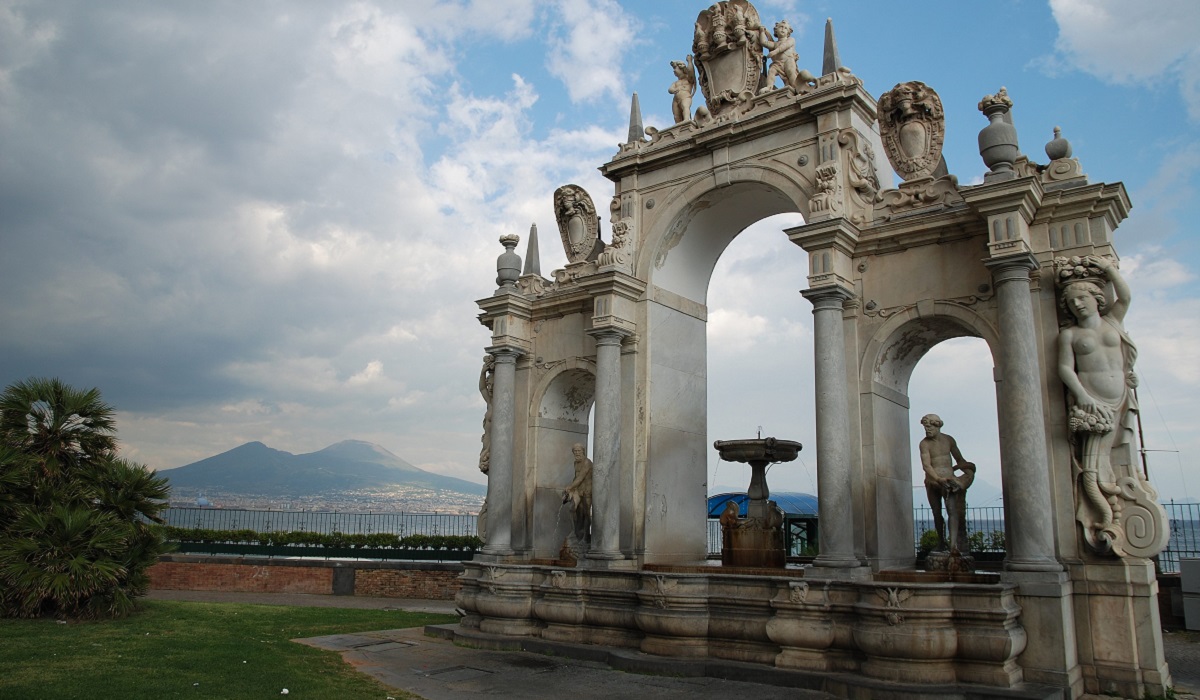
Photo: Fabrizio Reale
The Giant Fountain, also known as the Immacolatella, located in via Partenope, was instead commissioned by the viceroy Don Antonio Alvarez de Toledo, Duke of Alba, who once again entrusted the work to Pietro Bernini and Michelangelo Naccherino. Its two names come from the places that hosted it throughout its history: at first, it stood near the Royal Palace, where the statue of the Giant, found at Cuma, was located, and later towards the pier, opposite the building known as the Immacolatella. It was then moved to Piazza del Carmine, in the small gardens of via S. Pasquale a Chiaia, and finally, to its permanent location in via Partenope, in 1905. Structurally, it rises on a base and is formed by three round arches; the basin depicts sea creatures, while on the sides, two river statues hold “sea monsters”. At the side ends, finally, two caryatids hold cornucopias.
The Sebeto Fountain

Source: liberopensiero
The Sebeto Fountain (or Fonseca Fountain) stands at the end of Via Caracciolo, in Largo Sermoneta. It was built in 1635 at the behest of the viceroy Manuel Zuñiga y Fonseca, Count of Monterrey, who entrusted the design to Cosimo Fanzago, who worked on it together with his sons. It originally stood on what is now via Cesario Console, but was later moved to the seafront in 1939. It is formed by an arch, at the centre of which stands a statue of the Sebeto (an ancient river of Naples), and a base on which three basins rest. On the arch are a plaque and the coats of arms of the viceroy, the city and the king.
The Siren Fountain
Source: charme.it
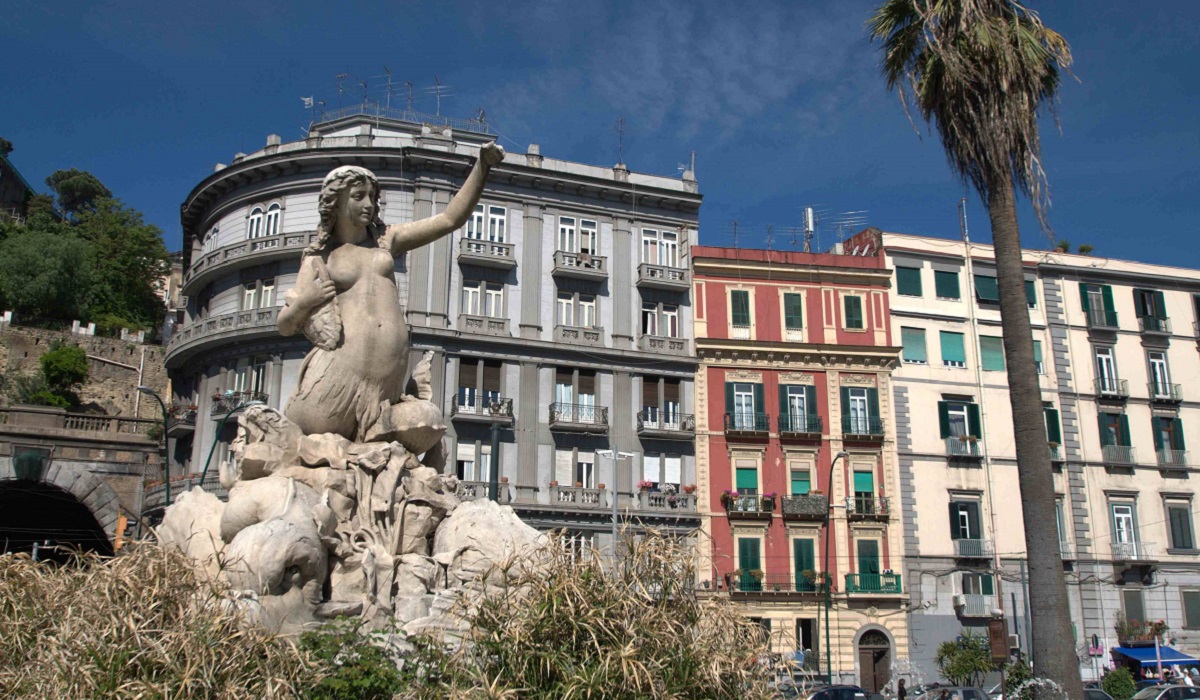
The Siren Fountain, built by Francesco Jerace in the mid-19th century and originally located in the gardens opposite the old Piazza Garibaldi station, is today found in Piazza Sannazzaro. It consists of a sunken circular basin in which, on a rock, stand four sea creatures, above which rises a siren, holding a lyre in her hands.
The Artichoke Fountain
Source: fotocommunity
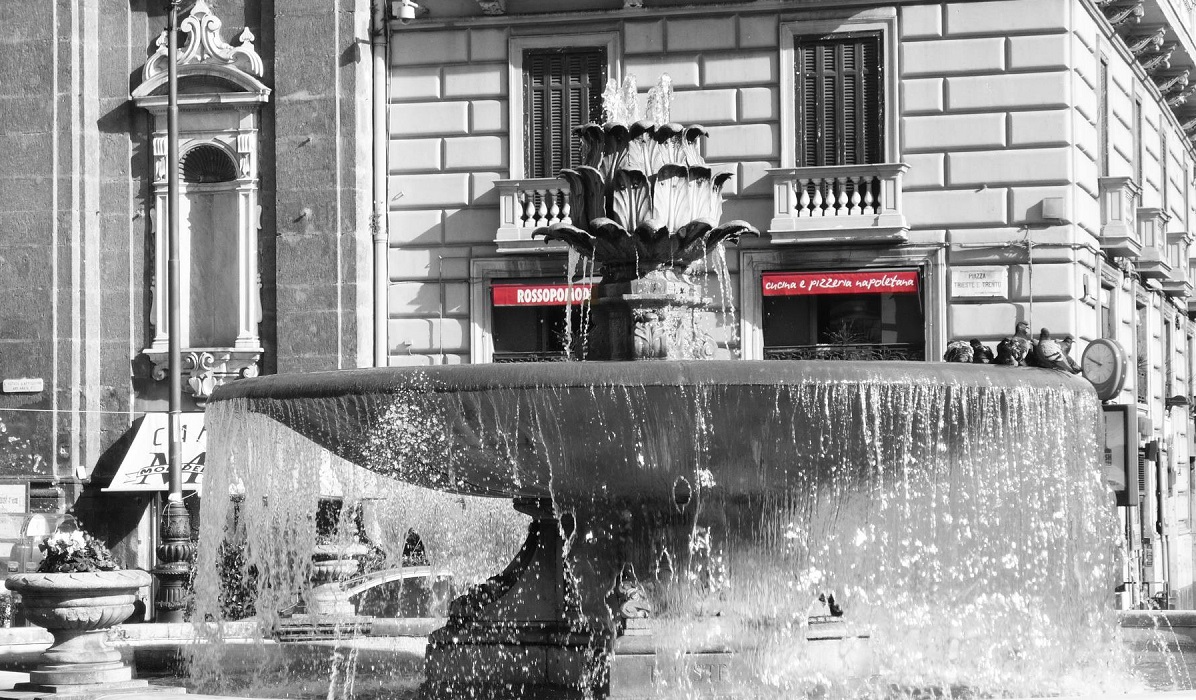
Commissioned by the then mayor of the city Achille Lauro, the Artichoke Fountain stands in Piazza Triste e Trento and was built in the mid-1950s. It features a large circular basin, surrounded by a small garden, at the centre of which stands a bowl containing the water that springs from a corolla-shaped vase. It is precisely this distinctive shape that earned it the nickname “carciofo” (artichoke) among Neapolitans.
The Monteoliveto Fountain
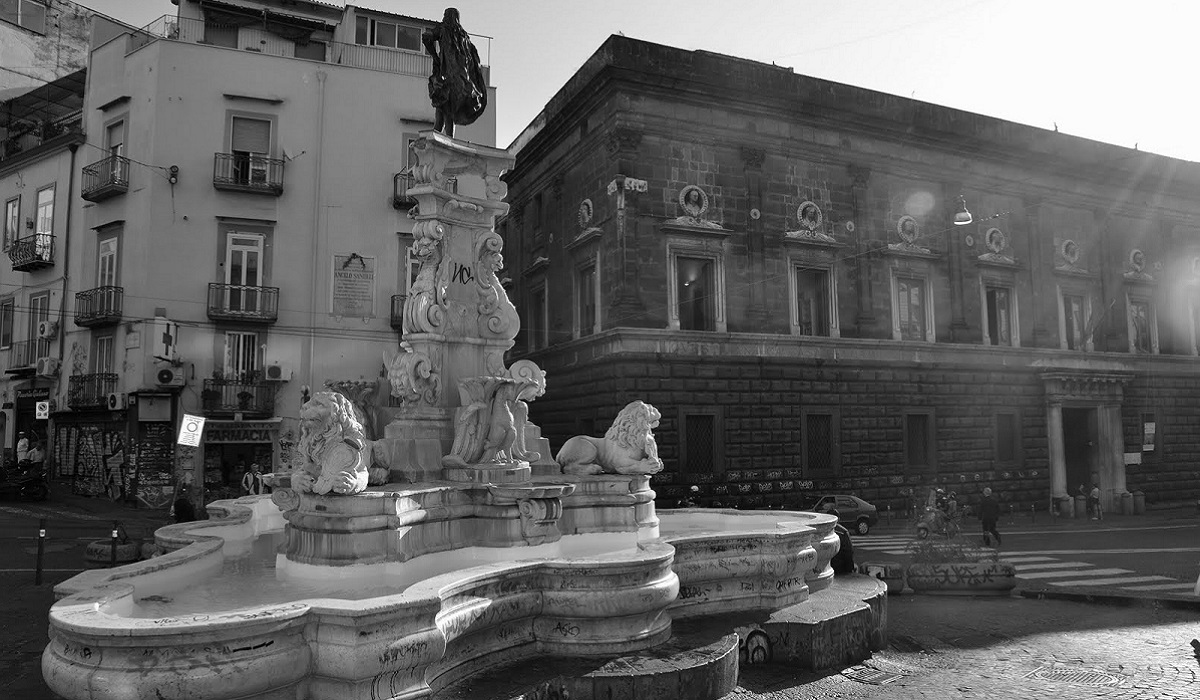
Photo: Fabrizio Reale
The Monteoliveto Fountain (or the Fountain of King Charles II), situated in Piazzetta Trinità Maggiore, was built at the behest of the viceroy Don Pietro Antonio d'Aragona, to celebrate the King of Spain, Charles II; work began in 1669 and continued for several years, partly due to indecision over how to depict the sovereign, who was then an adolescent. It features a three-armed, multi-lobed basin, on which stands a pedestal with three lions and three eagles, along with the coats of arms of the king, the viceroy and the city of Naples. At the centre, on a triangular base, stands a bronze statue of the king.
From the South, with love — Shop
 |
Napoli Tattà® Fontanelle Napoli — T-shirt The Fontanelle di Napoli, one of the city's most mysterious and fascinating places. Now on a t-shirt. 20,00 € Shop now → |
Posted in:
Living Naples
Related posts
-
 The Migliaccio
The Neapolitan migliaccio is a traditional cake made for the Carnival season. It's a soft, creamy cake made with...Read more
The Migliaccio
The Neapolitan migliaccio is a traditional cake made for the Carnival season. It's a soft, creamy cake made with...Read more -
 Pizza Tour: the best pizzas in Naples
In Naples, it's almost impossible to eat a pizza that isn't worth writing home about. There are hundreds and...Read more
Pizza Tour: the best pizzas in Naples
In Naples, it's almost impossible to eat a pizza that isn't worth writing home about. There are hundreds and...Read more -
 The Royal Pontifical Basilica of San Francesco di Paola
Over the centuries, Naples has seen the passing of countless peoples and different rulers, each of whom left their...Read more
The Royal Pontifical Basilica of San Francesco di Paola
Over the centuries, Naples has seen the passing of countless peoples and different rulers, each of whom left their...Read more -
 The Submerged Park of Baia
A unique and extraordinary place, closely tied to its surroundings. We find ourselves at the heart of the thermal...Read more
The Submerged Park of Baia
A unique and extraordinary place, closely tied to its surroundings. We find ourselves at the heart of the thermal...Read more -
 The National Library of Naples: the largest in Southern Italy!
It holds a collection of almost 4 million printed works, 30,000 manuscripts, a countless number of incunabula,...Read more
The National Library of Naples: the largest in Southern Italy!
It holds a collection of almost 4 million printed works, 30,000 manuscripts, a countless number of incunabula,...Read more
Leave a comment